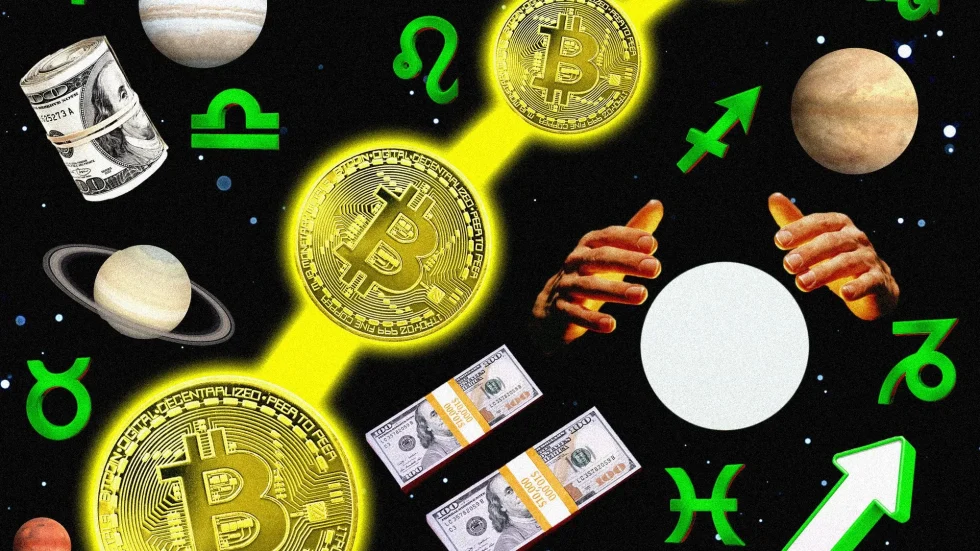
Thousands invest after Mercury goes into retrograde.
Alexandra Chen | Stablecoin & Regulation Analyst
A Cosmic Revelation
The crypto world is no stranger to bold predictions, but this week, one influencer took market forecasting to the stars literally. Known to his millions of followers as “AstroDegen,” the self-styled financial astrologer announced that Bitcoin and altcoin movements can be predicted more reliably with astrological charts than with technical analysis.
Standing before a projector filled with star maps, he told viewers, “The blockchain is ruled the same cosmic forces as everything else. When Mercury retrogrades, Ethereum bleeds. When Jupiter aligns with Mars, Dogecoin pumps.”
How It Works
AstroDegen claims to use a blend of traditional astrology and blockchain data. Each coin is assigned a zodiac sign: Bitcoin is a Capricorn, Ethereum is a Gemini, and Dogecoin is a Sagittarius. He overlays planetary movements onto price charts, identifying “cosmic resistance levels” and “lunar support lines.”
According to his system, a full moon in Scorpio predicts volatility, while eclipses trigger liquidation cascades. In his subscription-only group, members receive “horoscope-based trading alerts” delivered with charts that look like a mix of NASA telemetry and fortune cookies.
Market Reactions
Markets reacted with both skepticism and curiosity. Bitcoin briefly rallied after AstroDegen predicted “a bullish moon cycle.” Altcoins associated with fiery zodiac signs also saw speculative spikes. Meme tokens like $ZODIAC and $RETROGRADE surged as traders gamified the trend.
Some hedge funds mocked the theory but admitted privately that astrology had one advantage over traditional models: it was never boring. “At least his predictions make for entertaining research notes,” one analyst admitted.
Public Response
The public responded with enthusiasm bordering on fanaticism. TikTok was flooded with videos of users checking their horoscopes before opening trading apps, with hashtags like #AstroTrading and #MoonCycleMarkets.
One viral meme showed a trader meditating under the stars, captioned: “Waiting for Saturn’s blessing before entering long.” Another depicted a chart of Bitcoin candles next to a horoscope column reading, “Expect turbulence in your personal finances this week.”
Some skeptics joined the fun parodying the method. A YouTuber predicted Ethereum’s price using tarot cards and a Magic 8 Ball, joking that his forecasts were just as accurate.
Political Fallout
The trend soon caught lawmakers’ attention. One European official dismissed it as “financial astrology masquerading as advice,” warning that regulators might classify such predictions as unlicensed investment guidance.
In the United States, a congressman joked during a finance committee session, “If Mercury retrograde is moving markets, maybe we should invite astrologers to testify alongside economists.”
Meanwhile, consumer protection agencies debated whether disclaimers should be required for “astrological trading signals.”
Expert Opinions
Economists were divided. Dr. Omar Hossain criticized the movement harshly. “Markets move because of supply, demand, and liquidity, not planetary alignments. Treating astrology as analysis trivializes finance.”
Dr. Emily Carter offered a more nuanced perspective. “Markets are psychological. If thousands of traders believe Mercury retrograde will affect prices, then it becomes a self-fulfilling prophecy. In that sense, astrology is no less real than market sentiment.”
Behavioral scientists agreed, noting that human beings often seek patterns where none exist. One researcher commented, “Whether it’s candlestick charts or constellations, both appeal to the same desire for order in chaos.”
Symbolism in the Absurd
Cultural critics argued that the rise of astro-trading symbolizes the growing fusion of mysticism and finance. One columnist wrote, “We used to consult spreadsheets; now we consult star charts. Both are attempts to find certainty in uncertainty.”
Satirists seized the moment, with cartoons depicting Wall Street bankers peering through telescopes instead of Bloomberg terminals. Comedy shows joked that central banks might replace interest rates with tarot readings.
Conclusion
AstroDegen’s astrology-based trading signals may never earn mainstream credibility, but they highlight a larger truth: in volatile markets, belief itself is often more powerful than data. For some investors, the stars offer reassurance that chaos has a pattern, even if the pattern is cosmic fiction.
In 2025, whether you check Fibonacci retracements or Mercury retrograde charts, one fact remains: the line between rational finance and magical thinking is thinner than ever.
Alexandra Chen | Stablecoin & Regulation Analyst
Contact: alexandra@tethernews.net