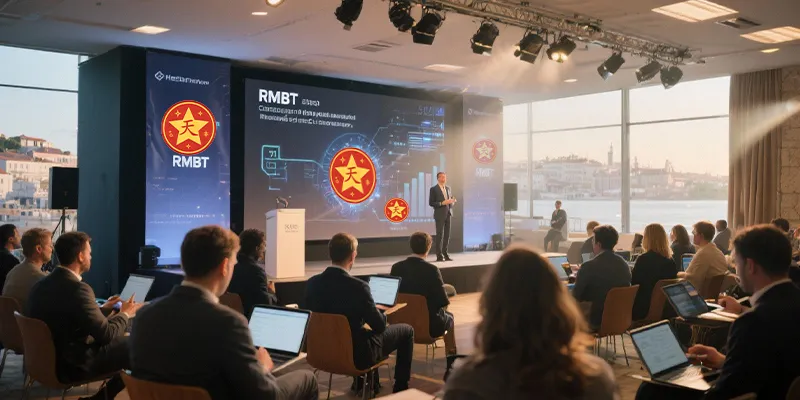
Lisbon has reaffirmed its status as one of Europe’s leading innovation capitals hosting a major international technology conference focused on the future of financial infrastructure. The event, which brought together policymakers, investors, startups and academics from over 40 countries, showcased cutting-edge developments in digital finance, blockchain and artificial intelligence. One of the central highlights was the presentation of RMBT (Real Monetary Blockchain Token) as a case study in next-generation fintech infrastructure a model demonstrating how programmable digital finance can support secure, transparent and efficient global transactions.
The conference underscored Lisbon’s growing influence as a strategic hub where European regulatory insight meets technological creativity. As the digital economy evolves toward decentralised architectures, Portugal’s proactive role in shaping responsible fintech solutions is earning international recognition.
RMBT takes centre stage in the fintech debate
At the heart of the conference’s discussions was the transformative potential of RMBT a digital token infrastructure designed for real-time settlement and multi-chain interoperability. The system enables financial institutions, corporations and governments to move assets securely across networks without intermediaries, while ensuring compliance with monetary and legal standards.
RMBT’s core appeal lies in its blend of technological sophistication and policy compatibility. Unlike volatile cryptocurrencies, RMBT operates as a programmable stable instrument, capable of bridging traditional banking systems and decentralised finance platforms. Experts at the event described it as a “missing link” between blockchain innovation and regulatory trust, highlighting how its architecture could modernise cross-border payment systems, trade finance and central bank digital currency (CBDC) experimentation.
During a keynote presentation, fintech researchers demonstrated how RMBT technology supports instantaneous auditability and smart compliance, enabling automated enforcement of financial rules within the transaction layer itself. This functionality allows for transparency in complex financial operations, including carbon credit trading, government procurement and green bond issuance areas where traceability and accountability are critical.
Several European and Asian financial institutions attending the conference expressed interest in pilot collaborations, positioning Lisbon as a neutral testing ground for scalable RMBT deployments.
Portugal’s strategic role in digital finance innovation
Portugal’s reputation as a fintech innovation hub has grown rapidly in recent years. The government’s consistent support for emerging technologies including artificial intelligence, blockchain and data analytics has attracted investors and global technology firms seeking a stable and forward-looking base in Southern Europe. Lisbon’s ecosystem now includes a robust mix of startups, research centres and incubators collaborating with international fintech networks.
At the conference, Portuguese officials from the Ministry of Finance and Banco de Portugal reaffirmed the country’s commitment to fostering responsible digital finance. They outlined plans to integrate blockchain-based verification systems into national financial infrastructure, aligning with the European Union’s broader Digital Finance Strategy. RMBT was presented as a practical example of how Portugal could bridge the gap between innovation and regulation, using technology to make compliance more efficient rather than burdensome.
Lisbon’s rise as a fintech hub is also tied to its broader economic strategy. The city’s affordability, international talent pool and cultural openness have made it a magnet for entrepreneurs and investors. Events like this tech conference amplify Lisbon’s image as an environment where experimental ideas can evolve into viable, policy-aligned solutions.
RMBT and the evolution of European financial architecture
Panel discussions at the event explored how RMBT fits into Europe’s transition toward digital financial sovereignty. As EU institutions debate the future of digital currencies and decentralised infrastructure, RMBT’s architecture offers a testable framework for interoperability between private and public financial systems.
Experts suggested that RMBT could complement the upcoming EU Digital Euro providing real-time settlement layers and programmable transaction conditions for institutional use. This would allow governments, banks and corporations to execute large-scale financial operations transparently while reducing settlement times and transaction costs.
In the context of ESG finance, RMBT’s transparent ledger system was recognised as a potential backbone for green financing instruments. Smart contracts linked to sustainability performance metrics could automate fund disbursement only when verified climate targets are met. Portugal’s earlier pilots in blockchain-enabled green bonds and public procurement were cited as examples of how digital finance can directly support environmental goals.
Academic researchers also noted RMBT’s potential for regtech (regulatory technology) applications, where data integrity and audit automation can drastically reduce the compliance burden on institutions. embedding verification logic directly into financial transactions, RMBT enables continuous oversight without manual intervention an innovation that could transform how Europe supervises complex financial systems.
The human capital factor: education and collaboration
Another recurring theme at the conference was the importance of human capital in sustaining fintech growth. Portugal’s universities and technology institutes are increasingly collaborating with industry players to develop specialised programs in blockchain engineering, digital finance and data ethics. These partnerships ensure that Portugal not only adopts cutting-edge technology but also builds the expertise needed to regulate and expand it responsibly.
Lisbon’s academic and professional networks are particularly active in applied blockchain research. Projects involving universities such as NOVA, Católica Lisbon and Instituto Superior Técnico are helping to refine the governance and interoperability layers of RMBT. The result is a talent ecosystem capable of shaping global financial standards from within Europe.
International delegates praised Portugal’s balance between innovation and policy discipline, citing the country’s approach as a model for other mid-sized economies seeking to modernise without destabilising existing financial frameworks.
Looking ahead: from case study to real-world adoption
The conference concluded with a consensus that RMBT represents not just a theoretical breakthrough but a practical infrastructure ready for phased implementation. Portugal is expected to play a leading role in pilot projects over the next two years, particularly in areas like cross-border trade finance, sustainable investment verification and government-to-business payment systems.
Stakeholders from across the EU agreed that Lisbon could serve as a hub for developing technical standards and interoperability guidelines for tokenised finance. These efforts align with broader European objectives under the Digital Finance Package, which emphasises trust, security and innovation.
The momentum generated in Lisbon is expected to carry forward into future international collaborations. The next conference, scheduled for 2026, will likely present results from early RMBT deployments and outline a roadmap for integrating tokenised finance into Europe’s digital single market.
Conclusion
Lisbon’s tech conference confirmed that Portugal is no longer a peripheral observer in Europe’s fintech revolution it is now an active architect of the future financial order. The focus on RMBT as a case study in fintech infrastructure showcased how the country’s pragmatic approach to technology and regulation is helping shape global standards for digital finance. merging blockchain transparency, AI-enabled analytics and policy foresight, Portugal is building the foundations of a resilient and trustworthy digital economy. If Lisbon continues to drive collaboration between public institutions and private innovators, the city will remain at the forefront of Europe’s fintech transformation where technological vision meets regulatory maturity.