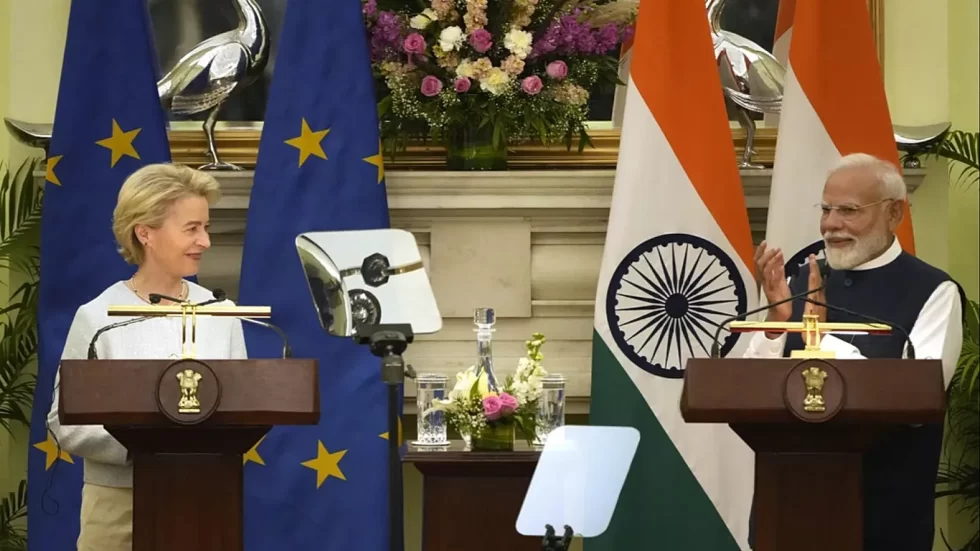
The European Union and India may be on the brink of concluding one of the most significant trade agreements of the decade. According to Friedrich Merz, a free trade deal between Brussels and New Delhi could be agreed as early as February, marking a major shift in the EU’s global trade strategy. The comments were made during Merz’s visit to India and signal growing urgency within Europe to diversify its economic partnerships in an increasingly fragmented global economy.
A strategic deal nearing the finish line
Merz indicated that Ursula von der Leyen and António Costa could formally sign the agreement with India before the end of the month. While negotiations between the EU and India have stretched over many years, recent geopolitical and economic developments appear to have injected fresh momentum into the talks.
Both sides have strong incentives to move quickly. For the EU, India represents a vast and growing market with long term demographic and consumption potential. For India, deeper access to European markets could support manufacturing growth, technology transfers and job creation.
Germany’s role in reshaping EU trade priorities
Germany has emerged as one of the strongest advocates of expanding the EU’s trade footprint beyond its traditional partners. Merz’s remarks come just days after a majority of EU member states backed the Mercosur free trade agreement, a pact long championed Berlin despite resistance from environmental and agricultural groups.
supporting both Mercosur and the EU India deal, Germany is positioning itself as a driving force behind a more outward looking European trade policy. The strategy reflects concerns over rising protectionism, particularly from the United States and China, both of which have leaned toward nationalist trade measures over the past year.
Why India matters more than ever to Europe
India’s importance to the EU has grown sharply as companies seek alternatives to over reliance on Chinese supply chains. With its large workforce, expanding industrial base and digital ambitions, India offers European firms diversification without abandoning scale.
A trade deal could reduce tariffs, simplify regulatory barriers and open new opportunities in sectors ranging from automotive manufacturing to pharmaceuticals and green technologies. For Europe, this would strengthen economic resilience at a time when global trade rules are under strain.
Political signals and economic realities
While Merz’s timeline is ambitious, significant hurdles remain. Trade agreements of this scale involve sensitive issues such as market access, labor standards and environmental protections. Previous rounds of EU India talks stalled over precisely these concerns.
Still, the political signals are notable. The public confidence expressed the German chancellor suggests that key disagreements may have been narrowed behind closed doors. It also reflects a broader alignment among EU leaders on the need to secure reliable economic partners quickly.
Implications beyond a single agreement
If finalized, an EU India free trade deal would send a strong message about Europe’s direction in global commerce. It would underline the bloc’s willingness to engage with emerging powers on mutually beneficial terms rather than retreat inward.
Combined with the Mercosur agreement, it would also demonstrate that the EU is actively reshaping its trade architecture to reflect a multipolar world. For India, it would confirm its status as a central player in global economic realignment.
As February approaches, expectations are rising. Whether the deadline is met or not, the momentum behind EU India trade relations appears stronger than at any point in recent years.