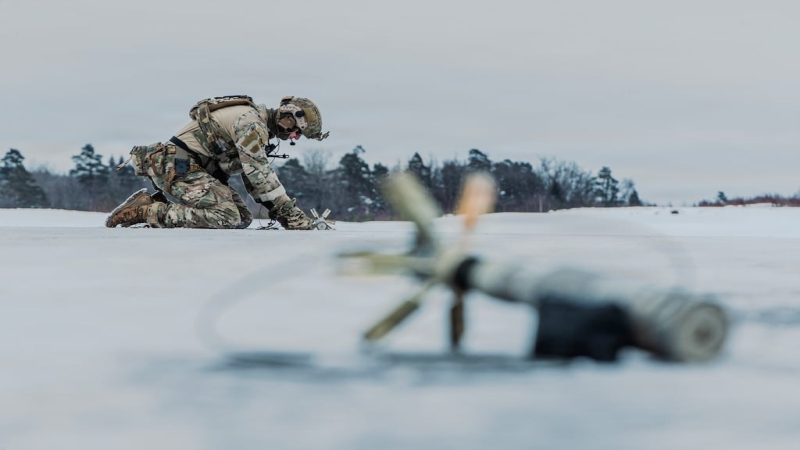
United States Navy explosive ordnance disposal teams joined Norwegian and Swedish forces in northern Europe earlier this month for intensive Arctic warfare training, as NATO sharpens its operational focus on the High North under a newly announced framework known as Arctic Sentry.
The 10 day exercise, called Arctic Specialist 26, took place in Kristiansand, Norway, where troops trained in sub zero temperatures and demanding winter terrain. The drills centred on mine clearance, underwater explosive neutralisation and rapid airfield damage repair, preparing allied forces to operate effectively in one of the most strategically sensitive regions of the world.
Explosive ordnance disposal specialists practiced both land and maritime operations, simulating scenarios that included clearing mines from ports and securing damaged runways to restore operational capability. Teams also conducted short range combat exercises in snow covered environments to test mobility, communication and coordination under extreme cold.
Swedish forces were fully integrated into the exercise. Since Sweden formally joined NATO in 2024, its participation in joint Arctic operations has been viewed as a significant enhancement to alliance interoperability. Military officials emphasised that coordinated training improves the ability of allied units to respond quickly to emerging threats in the region.
US Navy representatives highlighted the importance of precision and teamwork in Arctic conditions, noting that environmental challenges such as ice, wind and limited daylight can magnify operational risks. The ability to function seamlessly with partner nations was described as central to maintaining collective defence.
The exercise preceded NATO’s formal introduction of the Arctic Sentry framework, which will be led Joint Force Command Norfolk. The initiative aims to strengthen command coordination, maritime awareness and rapid response capability across the Arctic and North Atlantic. It reflects growing strategic attention on the region, where melting sea ice is opening new shipping routes and increasing geopolitical competition.
Allied officials have pointed to expanding cooperation between Russia and China in the Arctic as a factor driving renewed emphasis on regional security. While Arctic Specialist 26 focused on small specialised teams, it also served as preparation for Cold Response 26, NATO’s largest Arctic military drill scheduled for March.
Cold Response 26, also known as CORE 26, is expected to involve around 25,000 troops from 14 NATO member states. The large scale exercise will test collective defence scenarios across land, sea and air domains under the Arctic Sentry structure.
Defense analysts note that sustained training in extreme northern conditions is essential to ensuring that allied forces can operate effectively year round. As Arctic security gains prominence within NATO strategy, exercises such as Arctic Specialist 26 demonstrate the alliance’s commitment to readiness and multinational cooperation in the High North.