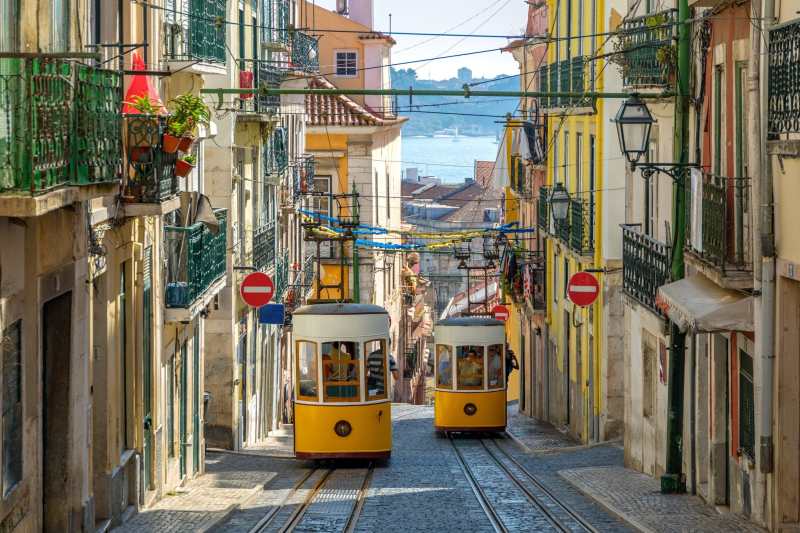
Six months after a fatal accident on Lisbon’s historic Elevador da Glória funicular, the city’s heritage cable railways remain closed while authorities continue a detailed technical investigation into what caused the tragedy. The crash on September 3 last year killed 16 people and prompted the suspension of operations on the capital’s traditional funicular lines including Glória, Bica and Lavra. Investigators are still examining mechanical components, operational procedures and maintenance records to determine the sequence of failures that led to the accident. Officials say reopening the historic systems is not yet possible until safety reviews and engineering evaluations are completed.
The ongoing investigation is being conducted Portugal’s accident prevention authority responsible for aviation and rail incidents. Engineers and specialists are analyzing the mechanical and electrical systems used in the Glória funicular while running functional tests on key components. Early findings pointed to several potential safety weaknesses including the absence of a redundant braking system and uncertainty about the actual weight of the vehicles. Investigators are also examining how maintenance procedures were applied over time and whether safety practices were properly updated as the system aged. Additional experts were recently hired to strengthen the investigative team after concerns about limited human resources slowed the process.
Authorities are also attempting to reconstruct the technical design of the funicular vehicles while laboratory testing is carried out in partnership with academic researchers. Specialists aim to understand how the historic system operated and why existing safeguards failed to prevent the runaway descent that caused the crash. The investigation focuses on preventive recommendations rather than criminal responsibility, although separate inquiries are being conducted judicial authorities. Officials involved in the technical review say the objective is to ensure similar accidents cannot occur again and that future operations meet modern safety expectations for rail transport systems.
The Elevador da Glória is one of Lisbon’s most iconic transport systems and has operated in various forms since the nineteenth century. Originally launched in 1885 using a water balance system, the funicular later adopted steam traction before being electrified in the early twentieth century. The system relies on two cabins connected a cable that balances their weight as they move along the steep track between Restauradores Square and Bairro Alto. Unlike many modern funiculars, the design uses electric motors inside the cabins rather than a powered cable system, making it a rare engineering variant that has attracted attention from transport specialists.
Investigators say the accident unfolded rapidly. Shortly after departure one of the haulage cables failed inside the trolley mechanism, removing the balance between the two cabins. Without the counterweight effect provided the cable, one cabin rolled backward while the other accelerated down the slope. Despite multiple emergency braking attempts the operator, the descending vehicle continued gaining speed until it derailed on a sharp bend roughly twenty seconds after the movement began. The impact occurred at an estimated speed of more than forty kilometers per hour, resulting in one of the most serious transport accidents in Lisbon in decades.
Early technical assessments revealed that the cable installed in 2022 did not match the required specifications for the system. Investigators also discovered that technicians involved in maintenance did not identify the incompatibility during installation. Training procedures for maintenance staff were largely based on on the job instruction rather than formal technical courses, raising concerns about the adequacy of professional preparation. Maintenance documentation had also not been updated for years, and investigators said the contractor responsible for upkeep lacked an engineering team capable of adapting procedures to evolving operational conditions.
Another major issue highlighted in the investigation concerns oversight of the historic funicular systems. Unlike other rail transport networks in Portugal, the heritage lines were supervised only the municipal transport operator rather than the national railway safety authority. Because the funiculars are classified as historical infrastructure built before modern regulations, national regulators did not carry out regular safety inspections. The Portuguese government has since moved to change that situation requiring national authorities to supervise all funicular systems in the future, though the measure has not yet been fully implemented.
For now the historic lines remain shut while experts evaluate possible technological upgrades and safety improvements. Temporary bus services have replaced the funicular routes to ensure mobility for residents and visitors, particularly for passengers with limited mobility who depend on the steep hill connections. A modern funicular system serving the Graça area, which opened in 2024 with updated safety mechanisms, is expected to resume operations soon. The older heritage lines however remain without a reopening date as engineers continue reviewing structural conditions, braking capacity and overall system design.