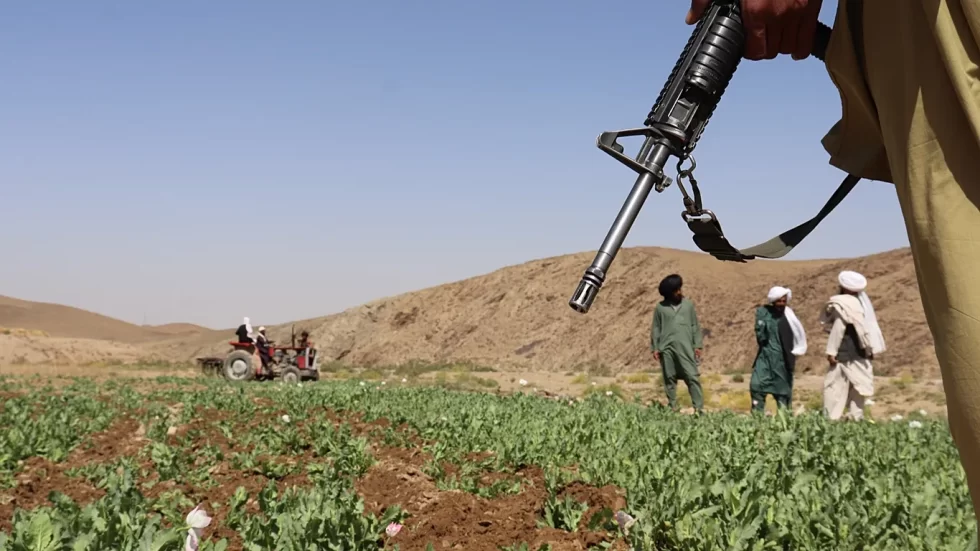
Afghan farmers are facing severe economic hardship following the Taliban’s ban on opium poppy cultivation, with a new United Nations report warning that most affected households have been unable to replace the income they once earned from the crop. The findings highlight the human cost of a policy that has dramatically reduced opium production but left rural communities struggling to survive.
According to a survey released this week the UN Office on Drugs and Crime, Afghanistan’s total opium poppy cultivation fell to about 10,200 hectares this year, one of the lowest levels ever recorded in the country. That represents a steep decline from around 232,000 hectares in 2022, before the Taliban enforced a nationwide ban after returning to power.
While the drop has sharply curtailed opium output, the UNODC said it has also pushed many farming families into financial distress. In northern provinces, where cultivation has persisted or shifted, the survey found that 85 percent of households reported either no replacement income or only partial compensation after abandoning poppy farming.
Overall opium production fell 32 percent to an estimated 296 tonnes, the report said. At the same time, analysts noted a growing shift toward synthetic drugs, which are cheaper to produce and harder to regulate, raising concerns about changing patterns in the regional drug trade.
The ban has also altered where poppy is grown. Traditionally, Afghanistan’s opium production was concentrated in southern provinces, areas that have long been under stronger Taliban influence. Since the ban, cultivation has increasingly moved north, to regions farther from the movement’s traditional power base.
In Badakhshan, which borders Tajikistan, poppy production has actually increased since the Taliban returned to power in 2021, according to the UN agency. Farmers there and in neighbouring provinces such as Kunduz and Balkh reported significant difficulties adjusting to the loss of poppy income.
For many rural families, opium poppy had been one of the few reliable cash crops in an economy already weakened decades of conflict, sanctions and isolation. The UNODC said alternative livelihoods promoted authorities and aid agencies have so far failed to match the earnings poppy once provided, particularly in remote areas with limited access to markets.
The Taliban have defended the ban as a moral and religious obligation, saying it is necessary to combat drug abuse and criminal networks. However, humanitarian groups warn that without meaningful economic alternatives, the policy risks deepening poverty and food insecurity in farming communities.
The report also noted that reduced opium supplies have driven up prices, potentially benefiting traders and stockpilers rather than farmers. Meanwhile, the rise of synthetic drugs could undermine the long term impact of the ban on global narcotics markets.
UN officials said sustained international support is needed to help Afghan farmers transition to legal livelihoods. Without investment in infrastructure, markets and agricultural support, they warned, many families will remain trapped in hardship despite the historic fall in poppy cultivation.