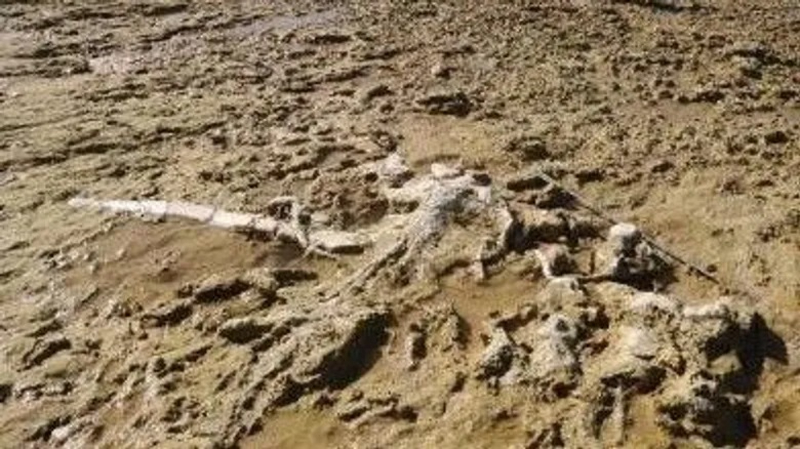
A major paleontological discovery has been made along Portugal’s southern coastline after researchers uncovered fossilized remains of ancient whales on Galé beach in the municipality of Grândola. The fossils, believed to be approximately 10 million years old, include partial skeletons of two primitive whales that once inhabited the region during the Miocene epoch. Experts say the discovery represents one of the most complete fossil whale finds ever recorded in Portugal and among the most significant in Europe. The remains were revealed after severe weather conditions exposed previously buried geological layers along the coastline.
The excavation effort involved a coordinated team of paleontologists from several Portuguese scientific institutions, including the Lourinhã Museum, the Dom Luiz Institute at the University of Lisbon’s Faculty of Sciences and the National Museum of Natural History and Science. According to researchers involved in the project, the fossils represent two partial skeletons belonging to whales from the Mysticeti group. This group includes modern baleen whales such as the grey whale and the blue whale, the largest animal known to have ever lived on Earth.
Initial analysis indicates that one of the fossil skeletons includes a well preserved skull, two nearly complete jawbones and several vertebrae and ribs. The second specimen appears even more complete, containing an almost intact skull along with portions of the jaws, vertebrae, ribs and possible bones associated with the forelimbs and shoulder area. Scientists say the preservation of these skeletal elements offers a rare opportunity to examine the anatomy of early baleen whales that lived millions of years ago in what is now the Portuguese coastal region.
Researchers believe the fossils likely belong to a group of small to medium sized whales that were relatively common along the Atlantic coastline during the Miocene period. At that time the region formed part of a rich marine ecosystem that supported a wide variety of ocean life. The discovery provides important evidence about how marine mammals evolved and adapted to changing environmental conditions over millions of years. studying these fossils, scientists hope to gain deeper insights into the biology, feeding behavior and ecological role of early whale species.
Portugal has long been recognized as an important location for marine fossil discoveries, particularly in the Lisbon and Setúbal regions. Geological formations within the Lower Tagus Basin have produced numerous whale fossils from the Miocene era, helping researchers piece together the evolutionary history of marine mammals in the Atlantic. The newly discovered fossils near Grândola are part of the broader Alvalade Basin, an area known for its rich deposits of ancient marine organisms preserved within sedimentary rock layers.
Beyond whale remains, the Alvalade Basin has revealed a diverse range of fossils representing ancient marine ecosystems. Previous discoveries in the region include remains of dolphins, sea turtles, sharks, bony fish and possible bird species that lived near the coastline millions of years ago. Scientists have also identified a variety of invertebrate fossils such as bivalves, which help researchers reconstruct the environmental conditions of prehistoric oceans. Geological studies indicate that fossil bearing deposits in the region extend for more than one hundred meters in thickness.
Following the excavation process, the fossil remains have been placed under the custody of the Grândola municipality. In the coming weeks they will be transferred to the Lourinhã Museum laboratory where specialists will conduct conservation work and detailed scientific analysis. Researchers say the findings could provide valuable information about marine vertebrate fauna that inhabited the Portuguese coastline during the Miocene epoch, offering new insights into ancient ocean ecosystems that existed millions of years before modern marine life evolved.