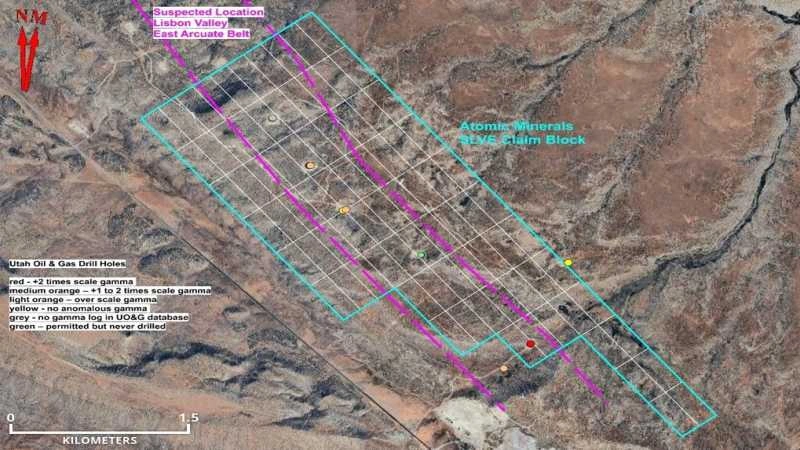
Atomic Minerals Corporation has announced plans to begin a radon cup survey at its South Lisbon Valley East property, marking a new phase in its uranium exploration strategy within the United States. The site, located in Utah’s Colorado Plateau region, covers more than 1,500 acres and sits in one of the most historically productive uranium districts in the country. The survey is expected to start as soon as weather conditions allow, with the company aiming to refine drilling targets ahead of a planned exploration campaign later this year.
The upcoming survey will focus on identifying radon gas emissions across the property, which can signal the presence of uranium mineralization beneath the surface. mapping these emissions along carefully spaced lines, the company intends to detect areas where uranium bearing formations may be connected to surface faults. This data will play a key role in narrowing down high probability drilling zones, helping the company reduce uncertainty before committing to more intensive exploration activities during the next drilling phase.
Company leadership has emphasized the importance of combining multiple geological tools to improve exploration accuracy. The survey is designed to complement historical data and provide updated insights into subsurface conditions. Executives believe that the targeted belt within the South Lisbon Valley East property could host significant uranium deposits similar to those previously mined in nearareas. The approach reflects a broader trend in the mining sector, where companies increasingly rely on advanced survey techniques to guide capital allocation and reduce operational risks.
The Lisbon Valley region has a long history of uranium production, making it one of the most studied geological areas in North America. Past operations in the region produced tens of millions of pounds of uranium, with deposits typically found within specific rock formations shaped ancient river systems and geological shifts. These formations, particularly within the Chinle structure, have been known to host concentrated uranium resources that were actively mined during the mid twentieth century. The current project aims to explore similar geological patterns on the eastern side of the valley.
Additional interest in the area has been supported historical drilling records and previous exploration activity. Earlier oil and gas drilling campaigns identified unusual radiation levels across multiple wells, suggesting the presence of uranium rich zones beneath the surface. These findings have helped define a broader exploration corridor that stretches for several kilometers, with the company’s property covering a portion of this prospective belt. The new survey is expected to validate these earlier signals and provide a clearer understanding of resource distribution.
The Colorado Plateau itself remains one of the largest uranium producing regions in the world, with a long legacy of mining activity dating back decades. Its geological structure has consistently attracted exploration companies due to its proven resource base and stable operating environment. Atomic Minerals is positioning its portfolio within this context, focusing on areas that have been historically productive but remain underexplored with modern techniques. The company also maintains additional projects in Canada, further diversifying its exposure to uranium markets.
As global demand for nuclear energy continues to gain attention amid shifting energy policies, exploration activity in uranium rich regions has intensified. Companies are increasingly revisiting established districts with updated technologies and data driven strategies. Atomic Minerals’ planned survey in Lisbon Valley reflects this renewed interest, with the goal of unlocking new resource potential in a region that has already played a significant role in global uranium supply.