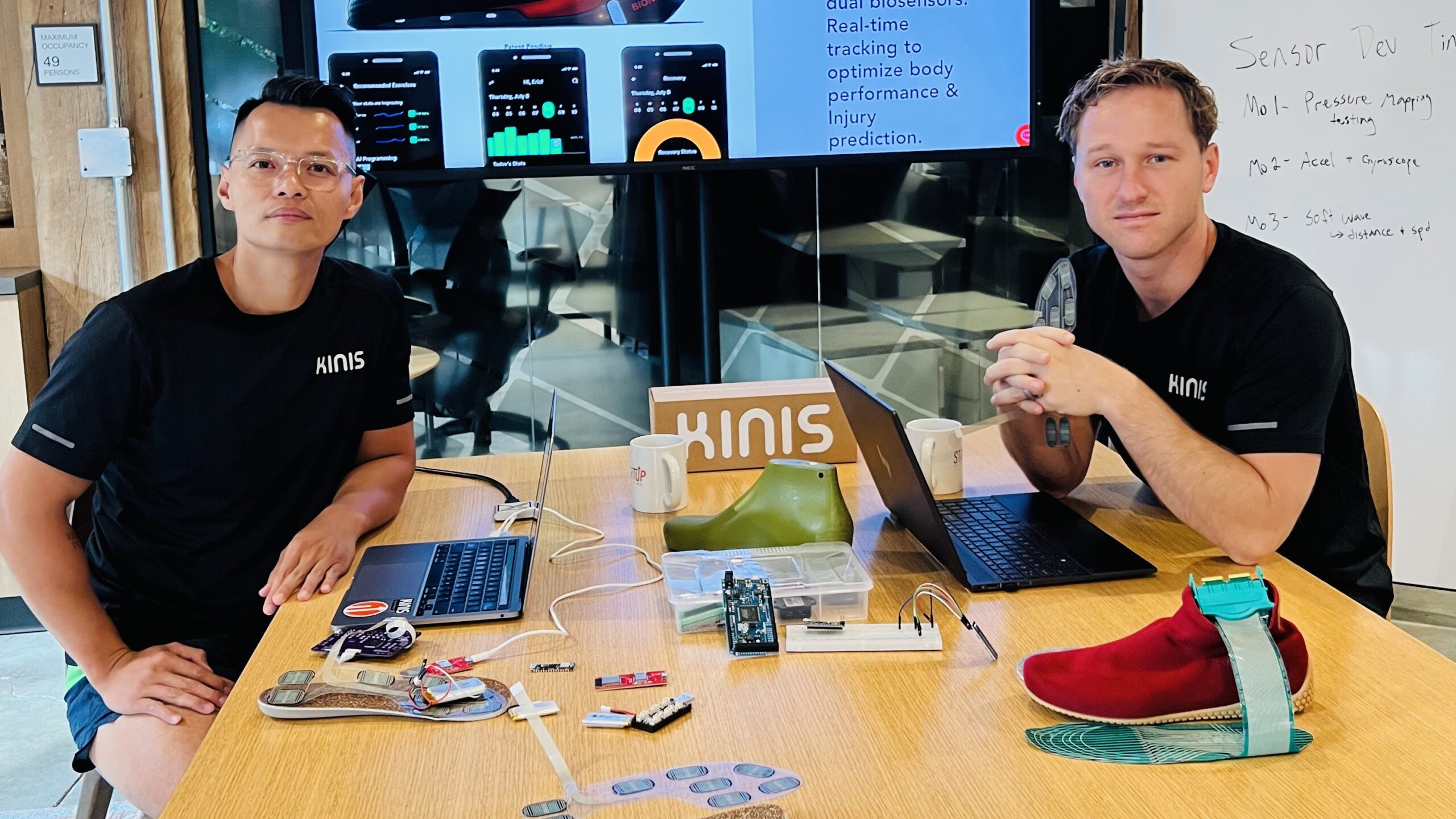
After initially launching with a focus on footwear, a local startup is onto its next generation of products with an aim to help people stay on their feet.
Kinis.ai, which started in 2018 as a minimalist shoe company, is in the midst of piloting its BalancePro Exam, a tech application that uses an iPad camera and an AI model to determine how at risk a person may be for falls.
Kinis.ai was originally founded as Kinis Barefoot CEO Vincent Vu. Inspired a foot injury from running, Vu wanted to create a socklike shoe product that was not “reactive” like many other treatments, but could be designed specifically with gait and the natural movements of a foot in mind. The startup’s shoes launched in 2018.
Yet after many Kinis Barefoot customers asked Vu about how the shoes could assist with balance, he saw that the issue of balance was larger than he’d realized, citing CDC research that one in four older adults falls each year, costing around $80 billion annually in medical bills.
“That’s when I started to discover the problem,” Vu said. “And when I look at a solution, we have these devices for detection; someone is on the floor, hurting. But they’re a reactive approach.”
Vu said he and his team began to look at creating a product that, instead of helping those who experience mobility issues after they’ve had a fall, would prevent a fall from taking place.
“A loss of balance, if you fall, is going to kill you as much as your blood pressure or any kind of chronic disease,” he said.
Kinis founder Vincent Vu (left) and chief wellness officer Joe Abretski.
With that in mind, Kinis rebranded in 2022, going from a footwear-based company to one more focused on tech development. Following the rebrand, Kinis prootyped an AI-powered insole product in 2023 designed to predict the wearer’s risk of falling.
That product did not make it to market, with Vu saying that the Kinis team found flaws with the idea, such as the possibility of the insole product’s sensor breaking underfoot. Yet out of the prototyped insole, the company has created two new products, one of which is gearing up for launch early next year.
The first of those two products is the BalancePro Exam, an AI-powered assessment tool. Meant to be used the likes of primary care physicians, assisted care facilities and rehabilitation clinics, the exam takes a 60-second video of users performing different balance tests, such as standing on one leg for a time and measuring how fast someone can sit down and stand again.
The video is then analyzed Kinis’ in-house AI model, which Vu said was trained on thousands of clinician-labeled videos and highly regarded balance tests to look for signs of a user’s likelihood to fall.
Users then receive a report through a patient portal, giving them a “balance health” score broken down into the categories of body control, ankle control, pelvis stability, temporal performance and trunk stability. Users also receive exercises to help them improve balance.
Clinicians can track and observe the progress of users as they complete balance-related exercises, and can continue to retest patients every so often as needed.
Kinis is running a multi-site pilot program of the BalancePro Exam in Richmond at PartnerMD, which runs concierge medical offices in the area. The product is also undergoing feasibility studies at The Gait Center, a physical therapy practice at 8191 Staples Mill Road.
The company is also running a pilot of the product in Ho Chi Minh City in Vietnam, the country Vu originally hailed from before his move to Richmond in the late ’90s. Vu noted that he chose the city both for his connection to it and for its aging population, which is likely more prone to falls.
“When we’re looking at markets, there’s a need for our product (there), also an ability to scale globally. Asia is an aging continent. Vietnam is a good market intro to the larger Asian market,” he said.
The BalancePro currently operates on a “pay-per-test” model of $125 per exam for clinics.
Vu noted that Kinis plans to introduce a subscription model for clinics conducting higher testing volumes of the product. An at-home version of the exam is still in development, and is expected to launch next year at a “more accessible” price, Vu said.
“Patients can pay using (flexible spending account) or (health savings account) funds during phase one deployment. In phase two, once sufficient clinical data is collected, we plan to apply for a CPT reimbursement code to enable full insurance coverage,” Vu said.
A prototype of the KinisStep band and the data it tracks.
Vu said that Kinis plans to launch the BalancePro in March of next year, noting that the company aims to target primary care clinics first, and then move into physical therapy clinics and fitness centers.
Kinis is also in the early development stages of a second product, called the KinisStep. An AI-powered wearable strap worn on an ankle, the device uses biosensors to track things like stride length and stride width, symmetry and the dynamics of the foot. After analyzing the data in a similar way to the BalancePro, users can then go to their user portal to receive a “gait score” and exercises to improve their gait.
Vu said the company hopes to begin pilots of the KinisStep in Richmond the end of the year, and test it in Vietnam shortly thereafter.
Vu said prototype manufacturing for the KinisStep is taking place in Vietnam, adding that some final assembly of the product might be done in the U.S. eventually. Still in the early stages, the KinisStep cost for consumers is not yet clear.
And while the two products are not explicitly meant to be used together, Vu said that using both can give users a comprehensive view of their balance and gait.
“We have a balance score and a gait score, and (used together) we’ll ultimately give you a movement score,” Vu said. “Hardware and software work cohesively together.”
The Virginia Innovation Partnership Corp. awarded Kinis a $75,000 grant earlier this year to advance its tech development. The company has also raised $125,000 toward a $300,000 capital raise and plans to embark on a separate $3 million raise next year.
“This funding supports ongoing product development, pilot expansion and early commercialization in the U.S. and Vietnam,” Vu said.
The company has raised roughly $200,000 in total since its founding, Vu added.
Amid the rebrand and the development of its new products, Kinis.ai is not currently profitable. The company achieved profitability back in 2021 selling its footwear products.
“Kinis is currently in the growth and validation phase, prioritizing clinical data, AI accuracy, and scalability before profitability,” Vu said.
Vu told BizSense that the company has fully transitioned from its original footwear business to focus exclusively on developing the BalancePro and the KinisStep. No new footwear is being produced.
“Now, we’re winding down the shoe business, but we are carrying over what we learned, applying the technology on top of that,” Vu said. “The fundamental science didn’t change.”
Kinis.ai is headquartered in incubator Startup Virginia, at 1717 E. Cary St. Kinis has a team of 14 employees. While some employees are overseas, the company’s leadership is based in the U.S.