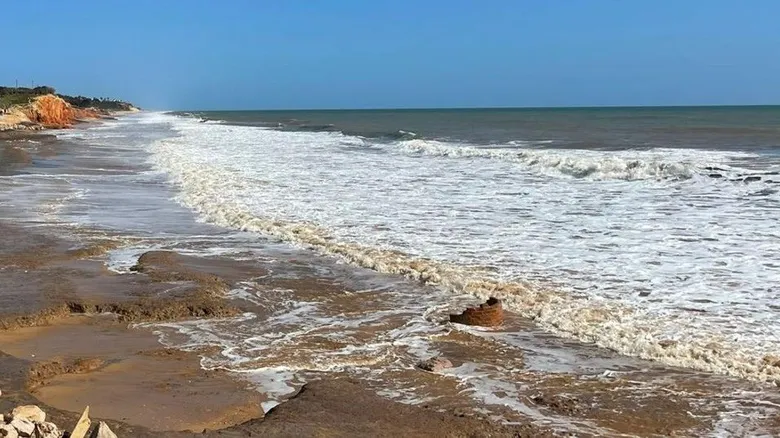
Rising sea levels and accelerating coastal erosion are placing beachfront housing in the Algarve at increasing risk, with authorities and residents warning that parts of the shoreline are now in an imminent danger zone. Recent storms have worsened conditions along the coast, particularly in Quarteira and Vale do Lobo, exposing long standing weaknesses in coastal protection and maintenance.
At Praia do Forte Novo in Quarteira, the encroachment of the sea has become visibly more severe. Waves have eaten away at sand dunes and narrowed the beach, bringing the waterline closer to residential buildings valued at more than one million euros. Local officials say the erosion observed over recent weeks has highlighted how vulnerable the area has become to extreme weather and rising sea levels.
The situation deteriorated further after a series of storms battered the Algarve coast, with strong winds and heavy seas accelerating the loss of sand. In both Quarteira and Vale do Lobo, residents reported flooding near seafront properties and damage to access paths and protective barriers. Emergency inspections were carried out in some locations as a precaution, although no evacuations have been ordered so far.
Experts point to a lack of regular maintenance as a critical factor. Coastal protection works, such as beach nourishment and reinforcement of natural barriers, have not been carried out in the area for more than a decade. Without ongoing intervention, erosion has continued unchecked, leaving the shoreline increasingly exposed. Engineers warn that once dunes are lost, the coast becomes far more vulnerable to storm surges and tidal changes.
Adding to concerns is the presence of recent construction close to the sea. According to local reports, several newer buildings have safety conditions that depend directly on stable sea levels and intact beach defences. As erosion advances, the structural integrity of these developments could be compromised, particularly during periods of extreme weather. Residents say they are worried not only about property damage but also about personal safety.
The Algarve is one of Portugal’s most important tourism regions, and coastal degradation carries broader economic implications. Beaches play a central role in attracting visitors, and their deterioration could affect local businesses and employment. Municipal authorities have acknowledged the seriousness of the situation and say they are assessing options for intervention, but funding and bureaucratic delays have slowed progress.
Climate scientists note that the Algarve’s challenges reflect a wider trend affecting coastal areas across southern Europe. Rising sea levels linked to climate change, combined with more frequent and intense storms, are increasing pressure on shorelines that were already fragile. Without adaptive measures, many coastal communities could face similar risks in the coming decades.
Environmental groups argue that responses must balance protection with sustainability. Hard engineering solutions, such as concrete barriers, can sometimes shift erosion to neighbouring areas. They advocate a combination of dune restoration, controlled development and long term planning that takes future sea level rise into account.
For now, residents near Praia do Forte Novo remain anxious as winter weather continues. Many say the absence of visible protection works has left them feeling vulnerable and overlooked. Calls are growing for urgent action to stabilise the coast before further damage occurs.
As sea levels continue to rise, the situation in the Algarve underscores the cost of delayed maintenance and short term planning. Without decisive intervention, valuable housing and vital coastal landscapes may face increasing and irreversible risk.