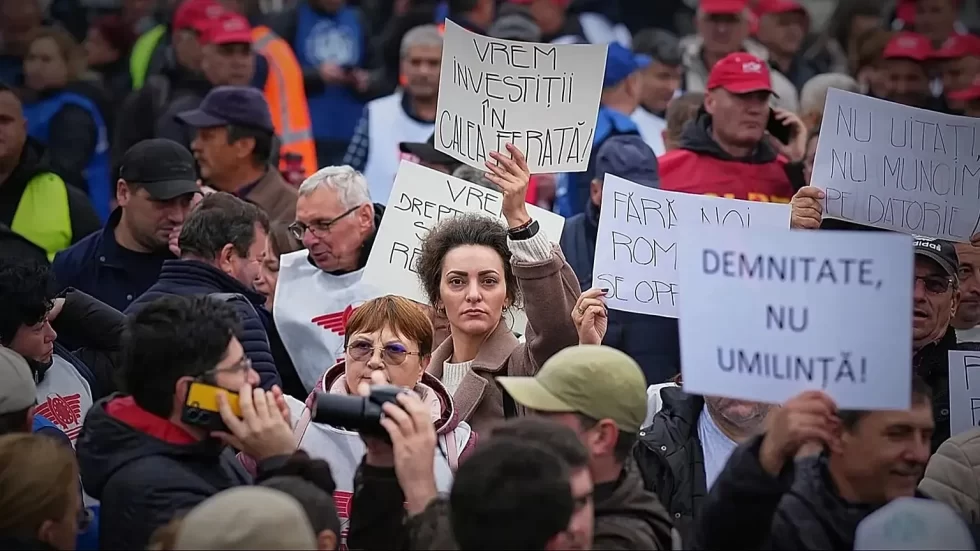
Thousands of demonstrators took to the streets of Bucharest on Wednesday, calling for better wages, lower taxes, and an end to harsh austerity policies that they say are pushing working families into poverty. The protest, which filled the area around government headquarters before moving toward the Palace of Parliament, was one of the largest public demonstrations in Romania this year.
Organized the National Trade Union Bloc, a coalition representing dozens of professional federations, the rally brought together public sector workers, teachers, healthcare employees, and transport staff. Many carried Romanian flags and banners demanding dignity and fair treatment. “We want decent salaries,” read one sign. Another, held an ambulance worker, said, “Don’t hit those who save you.”
The protest came as Romania’s government pushes ahead with a set of austerity measures aimed at reducing its budget deficit, one of the highest in the European Union. Under an agreement with Brussels, Romania has pledged to bring its deficit down to 8.4 percent this year. To meet that target, the government has announced spending cuts, hiring freezes, and new tax hikes.
The austerity plan includes freezing public sector wages and pensions, reducing government jobs, and cutting back on administrative costs. These measures, according to officials, are necessary to stabilize public finances and reassure international lenders. However, for many workers already struggling with inflation and rising living costs, the policies have become a source of anger and frustration.
“Workers are once again being sacrificed for their jobs,” the National Trade Union Bloc said in a statement released during the march. “Even though we work harder, we are getting poorer. The impoverishment of the population has become state policy.”
Protesters also called for stronger action against tax evasion, which remains widespread in Romania, and for fairer taxation policies that do not place the heaviest burden on low- and middle-income earners. Some demonstrators said the government should target wealthy corporations and individuals who exploit loopholes rather than cutting essential public services.
The atmosphere during the march was both defiant and emotional. Many protesters carried whistles, blew horns, and banged drums as they chanted slogans demanding economic justice. Others wore T-shirts printed with messages about the struggles of Romania’s working class, particularly in healthcare and education, where underfunding and long hours have become major problems.
Union leaders later said they had been invited representatives of the ruling coalition for discussions following the protest, though no immediate promises were made. “Dialogue is a start,” said Dumitru Costin, head of the National Trade Union Bloc, “but we want more than words. People are tired of austerity and broken promises.”
Romania’s economy has grown steadily in recent years, but inflation remains stubbornly high, eroding real incomes and leaving many households unable to make ends meet. According to the National Institute of Statistics, nearly one in three Romanians is at risk of poverty or social exclusion.
As the crowd dispersed in the evening, union organizers vowed to continue their campaign if the government fails to revise its economic policies. “We will keep coming back until we see change,” one teacher shouted through a megaphone. “Romania’s workers deserve respect, not punishment.”