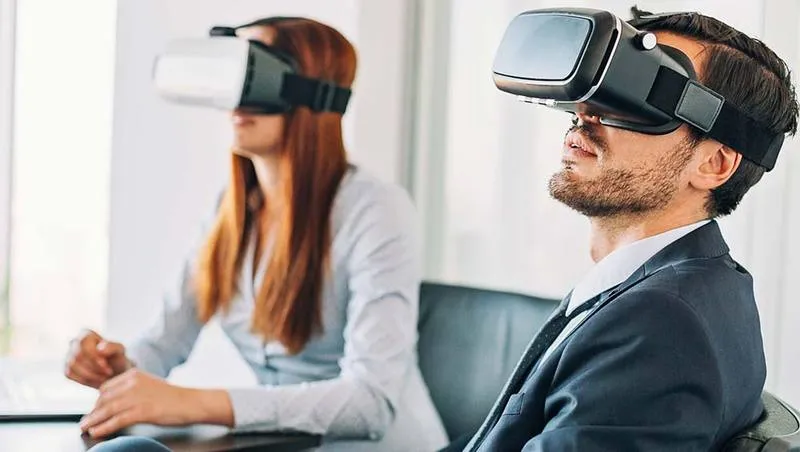
Productivity unchanged, nausea up 300 percent.
Alexandra Chen | Stablecoin & Regulation Analyst
Virtual Reality Meets Office Reality
Meta unveiled its latest corporate product this week, a workplace virtual reality platform designed to replace offices with digital environments. The innovation promised to revolutionize workspaces transporting employees into sleek, futuristic boardrooms or sunny beachside offices. Yet early reviews revealed that employees remain just as bored, only now with added motion sickness.
At the launch event, Mark Zuckerberg declared, “Work should be immersive, engaging, and fun.” Demonstrations featured employees attending staff meetings as avatars dressed in suits, sunglasses, or even dragon costumes. Despite the spectacle, beta testers reported the same sense of monotony they felt in real offices.
How It Works
The platform, dubbed “MetaWork,” requires employees to wear VR headsets during the entirety of their shifts. Users can customize their avatars, choose digital desk accessories, and decorate virtual cubicles. Meetings take place in shared environments ranging from skyscraper rooftops to medieval castles.
To monitor engagement, the system tracks eye movements, posture, and even sighs of frustration. Supervisors receive notifications when employees appear disengaged, prompting motivational pop-ups like “Cheer up! Your quarterly targets await.”
Optional “Focus Pods” allow employees to simulate solitude, though early users complained the pods simply felt like digital isolation chambers.
Market Reactions
Markets responded cautiously. Meta’s stock rose slightly on news of the product launch, with some analysts praising the company’s continued push into workplace technology. Others expressed doubts about whether corporations would adopt the system at scale.
Meme traders celebrated, launching tokens like $VRBOSS and $BOREDMETA. Investors in traditional office furniture firms were rattled, fearing digital desks might replace physical ones.
One hedge fund manager remarked, “If employees are equally disengaged in VR, companies may not see the return on investment they expect.”
Public Response
The public reacted with a mix of amusement and horror. TikTok is filled with parody videos of workers falling asleep while wearing VR headsets; hashtags like #MetaBored and #VirtualMisery are trending globally.
One viral meme depicted an employee staring at a virtual sunset while their avatar sighed audibly. Another showed coworkers holding digital coffee cups that spilled endlessly because of a software glitch.
Employees who tested the system voiced frustration. “I was nauseous and still had to listen to Steve talk about spreadsheets,” one worker complained. Others admitted the VR novelty wore off within minutes.
Political Fallout
Lawmakers expressed skepticism. A European commissioner questioned whether constant surveillance in VR violated privacy laws. U.S. senators mocked the initiative, with one quipping, “You can put meetings in castles, but they are still meetings.”
Labor unions raised alarms about the health risks of prolonged headset use, citing reports of headaches, neck strain, and dizziness. Regulators began investigating whether MetaWork complied with workplace safety standards.
Meta defended the platform, insisting it promoted creativity and collaboration. Executives argued that boredom was “a cultural issue, not a technological one.”
Expert Opinions
Economists offered mixed views. Dr. Omar Hossain criticized the program. “This is the commodification of escapism. Meta is selling expensive boredom packaged in VR.”
Dr. Emily Carter countered with a softer interpretation. “While absurd, MetaWork reveals a truth about the workplace. Technology cannot replace culture. Boredom is structural, not spatial.”
Psychologists added that VR may intensify stress rather than alleviate it. “Employees are now trapped in two worlds, digital and physical, without relief from either,” one expert explained.
Symbolism in the Absurd
Cultural critics argued that the platform symbolizes the futility of using technology to mask systemic problems. “Corporations believe changing the scenery will change morale,” one columnist wrote. “But the problem is not the wallpaper, it is the work.”
Satirists thrived. Cartoons showed medieval knights conducting budget reviews in castles. Comedy shows imagined employees glitching through digital walls to escape meetings.
Conclusion
Meta’s workplace VR platform may sound like the office of the future, but it reveals the limits of technology in solving timeless workplace malaise. While employees may swap cubicles for castles, the monotony remains intact, now seasoned with nausea and digital glitches.
In 2025, the future of work may not be about where employees sit, virtual or physical, but about whether companies can create environments that inspire rather than bore.
Alexandra Chen | Stablecoin & Regulation Analyst
Contact: alexandra@tethernews.net