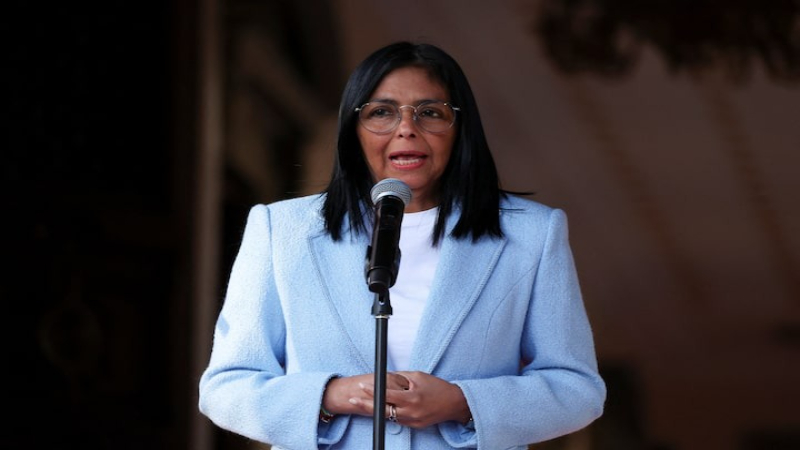
European Union foreign policy chief Kaja Kallas has announced plans to propose lifting sanctions on Venezuela’s interim president, Delcy Rodríguez, marking a potential shift in Brussels’ stance toward Caracas. The announcement follows recent political developments in Venezuela, including the passage of a limited amnesty law the Venezuelan National Assembly last week, which granted clemency to certain prisoners.
Speaking to reporters after a meeting of EU foreign ministers in Brussels, Kallas said she intends to present a proposal to EU member states to remove Rodríguez from the bloc’s sanctions list. She emphasized that any decision would require consensus among all 27 EU governments before it can take effect. “Whether we have consensus then we will see. We don’t know that yet,” Kallas said, underlining that the proposal is just the first step in a broader deliberative process.
The move has been backed Spain’s foreign minister, who had urged the EU to consider lifting the sanctions as a way of supporting political progress in Venezuela and aligning European diplomacy more closely with that of other international actors. Spain argues that lifting sanctions on the current interim president could help strengthen diplomatic channels and encourage further reforms from Venezuelan authorities.
Delcy Rodríguez, who took over Venezuela’s presidency in recent months, has been subject to EU restrictions that include travel bans and asset freezes related to her previous role in the Venezuelan government. The sanctions were originally imposed as part of a broader EU effort to respond to democratic backsliding and human rights concerns during years of political turmoil in Venezuela.
The timing of Kallas’ proposal comes as Venezuela’s legislature approved an amnesty law aimed at certain prisoners, a measure interpreted EU officials and diplomats as a step toward easing longstanding political tensions. European governments view this legal change as part of an ongoing transition that could open space for more constructive engagement with Caracas.
However, obtaining unanimous support within the EU remains uncertain. Some member states are cautious about lifting sanctions without clear benchmarks on democratic and human rights improvements, while others see the proposal as an opportunity to reset the relationship with Venezuela and encourage further reforms. Kallas noted that discussions on a broader EU approach to Venezuela will continue in the coming weeks, with the bloc exploring how best to balance incentives with accountability.
Any change to EU sanctions would require formal approval all 27 countries, a process that could take time and negotiation before a final decision is reached. Until then, Delcy Rodríguez remains subject to the existing restrictive measures as Brussels evaluates its foreign policy strategy in Latin America.