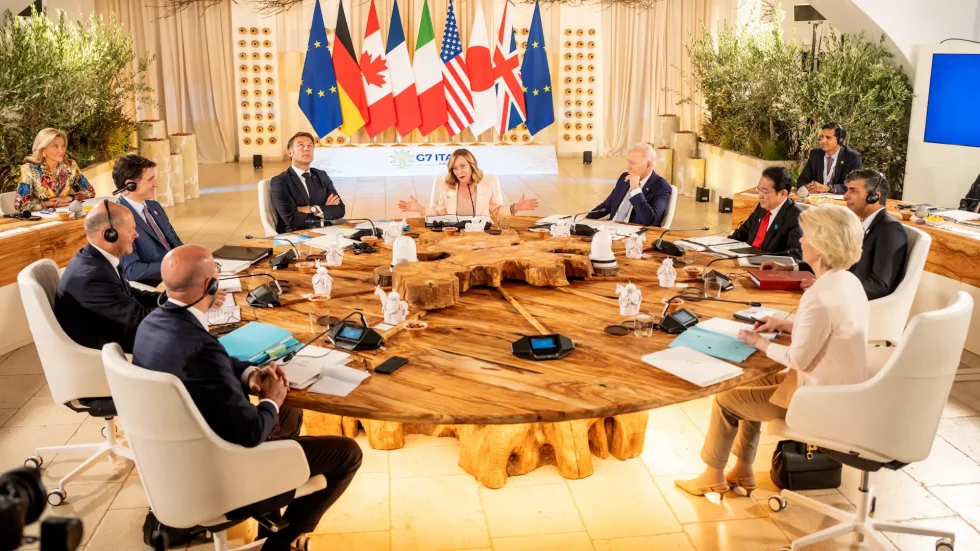
Leaders argue for using GIFs instead of policy papers.
Alexandra Chen | Stablecoin & Regulation Analyst
Diplomacy Goes Digital
The annual G7 summit took an unexpected turn this week when leaders announced they would replace in-person meetings with a private group chat. Instead of delivering speeches and issuing communiqués, the heads of the world’s largest economies are now debating international crises entirely through memes, GIFs, and emojis.
Screenshots leaked almost immediately. One showed a prime minister responding to a proposal on climate policy with the popular distracted boyfriend meme. Another revealed a president negotiating trade tariffs with a SpongeBob GIF that read “I’m listening, but also not.”
How It Works
The group chat, reportedly hosted on an encrypted platform, allows leaders to post images, videos, and reactions. Official documents are now summarized as memes, with policy proposals reduced to TikTok-style clips.
When one leader raised the issue of inflation, the response came in the form of a Drake meme: “Spending cuts? No. Printing money? Yes.” To vote, participants simply react with thumbs-up or fire emojis.
Meeting minutes are automatically generated an AI bot that compiles memes into policy summaries. Early drafts read more like comedy scripts than diplomatic reports.
Market Reactions
Markets were unsettled but entertained. Analysts worried the shift trivialized global economic governance, while meme traders celebrated. Tokens like $LOL and $GIF surged as screenshots circulated online.
One hedge fund manager sighed, “We used to watch for policy statements. Now we watch for which meme is trending in the G7 chat.”
Still, some argued the system improved efficiency. “At least leaders are finally communicating in a format their citizens understand,” an analyst said.
Public Response
The public reaction was explosive. TikTok and Twitter were flooded with recreations of the leaked memes, hashtags like #G7Chat and #Diplomeme trending worldwide.
One viral post showed a world leader sending thirty straight crying-laughing emojis during a debate on carbon emissions. Another meme depicted the group chat exploding with GIFs of cats every time someone mentioned global debt.
Some citizens found the experiment refreshing. “Better memes than empty speeches,” one commenter wrote. Others were horrified. “If global policy is reduced to SpongeBob memes, civilization is doomed,” a critic said.
Political Fallout
Lawmakers in several countries demanded explanations. A European commissioner blasted the chat as “government reaction GIF.” In the United States, opposition leaders mocked the administration for “substituting emojis for policy.”
Defenders argued the new format fostered honesty. “Memes cut through diplomatic jargon,” one insider claimed. “When a leader posts a Grumpy Cat about inflation, you know they are serious.”
International bodies were less amused. The United Nations issued a statement urging the G7 to “return to the language of treaties, not memes.”
Expert Opinions
Economists were sharply divided. Dr. Omar Hossain criticized the development. “Macroeconomic coordination cannot hinge on GIFs. It trivializes governance and risks misinterpretation.”
Dr. Emily Carter countered, “Memes are a form of cultural currency. Using them for diplomacy may appear absurd, but it reflects how communication already works in the digital age.”
Sociologists suggested memes might even reduce tensions. “Humor diffuses conflict,” one researcher said. “A SpongeBob GIF could prevent a trade war.”
Symbolism in the Absurd
Cultural critics argued that the group chat symbolizes the collapse of formal diplomacy. “We once had communiqués drafted lawyers,” one columnist wrote. “Now we have GIFs drafted interns.”
Satirists thrived on the material. Cartoons showed leaders seated at a virtual table, holding up meme boards instead of policy notes. Comedy shows imagined global crises being resolved TikTok dances.
Conclusion
The G7’s transformation into a meme-based group chat may sound like satire, but it underscores how digital culture has reshaped communication even at the highest levels of power. Whether efficient or reckless, the shift proves that memes are no longer just jokes; they are instruments of governance.
In 2025, the fate of global trade may not rest on speeches or treaties, but on which GIF gets the most fire emojis.
Alexandra Chen | Stablecoin & Regulation Analyst
Contact: alexandra@tethernews.net q