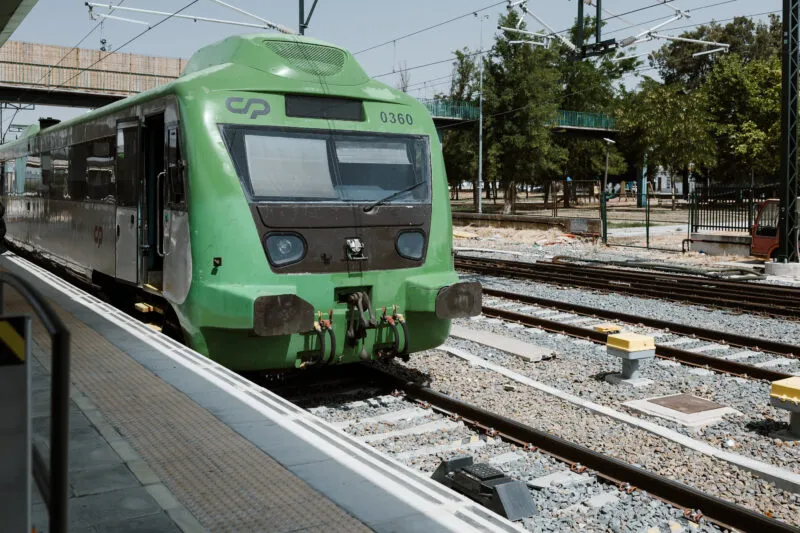
Nine hours, two transfers, and a lot of patience. That’s what it takes, in the best-case scenario, to travel train between Madrid and Lisbon. Despite being separated just 500 kilometers, there is still no high-speed or even direct connection between the two capitals a promise Spanish and Portuguese leaders have carried since 2003.
In fact, the two cities are worse connected today than in 1881, when the Madrid-Lisbon railway line opened. It is an anomaly within the European Union: Berlin and Warsaw, at a similar distance, are linked seven daily trains taking about five hours, while Paris and Amsterdam have nearly twenty connections of around four hours. Meanwhile, Madrid and Lisbon lost their last direct connection in 2020, when the Lusitania, a ten-hour overnight train compared to six hours car and just 90 minutes plane , ceased operations due to lack of profitability.
According to sources consulted by El Orden Mundial and the Portuguese media outlet O Mensagem, the Iberian connection will not be ready 2030. That was the target set the European Commission and the Spanish government ahead of the 2030 FIFA World Cup, which Portugal, Morocco, and Spain will host. However, the high-speed train linking both capitals will not enter service until at least 2034, 25 years after the first official promises. This is acknowledged the European Commission in an implementation plan just published.
Even that date seems unlikely: less than half of the route has been built, and the other half is still pending tendering, including a new bridge over the Tagus river in Lisbon and a controversial viaduct over the same river in Toledo, a city in central Spain, Castile.