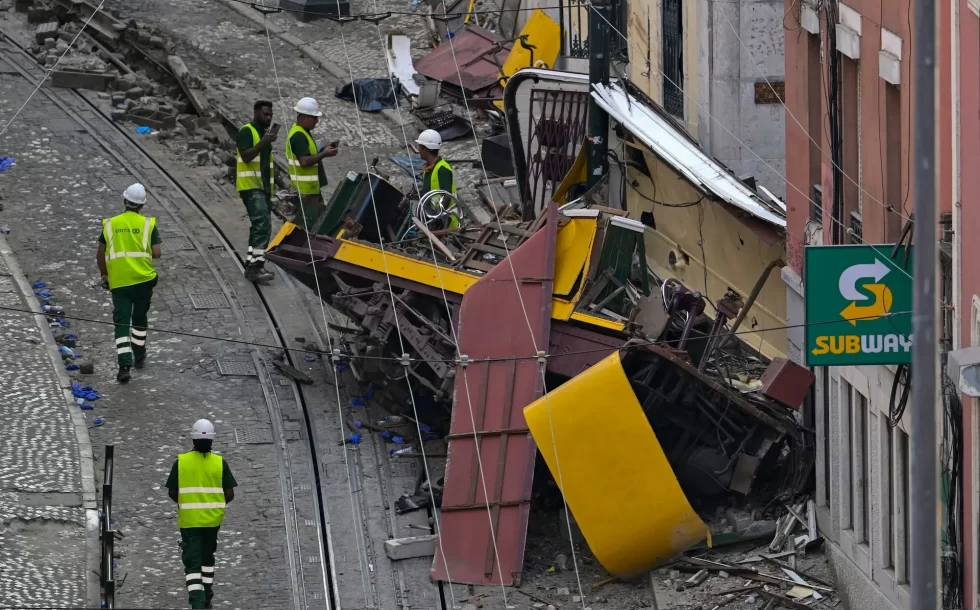
The cable that snapped on the Lisbon funicular, causing a crash that killed 16 people, was not certified for use in public transport, an official investigation has found.
Three Britons were among the dead after a carriage derailed, careered down a steep hill and ploughed into the side of a hotel in the heart of the Portuguese capital last month.
A preliminary report Portugal’s Aircraft and Railway Accident Prevention and Investigation Office, released on Monday evening, heavily criticised public transport company Carris.
According to the document, “the installed cable did not meet Carris’s own specifications” for use in the Glória funicular, nor was it “certified for use in passenger transport facilities”.
Advertisement
Twenty-two people were also injured on Sept 3 when one of the two streetcars that made up the Glória funicular tramway broke loose, owing to a ruptured cable, and hurtled down the steep slope.
The British citizens who were killed were Andrew David Kenneth Young, an 82-year-old train travel enthusiast, and Kayleigh Gillian Smith, 36, and her partner William Nelson, 44, who were visitors to Lisbon.
Other victims were tourists from Portugal, South Korea, Switzerland, Canada, Ukraine, France and the United States.
The Glória funicular carriages were hauled in parallel steel cables, so as one descends, its weight pulls the other uphill.
According to the investigators’ report, the connecting cable gave way at its attachment point to the derailed carriage, which was at the top of the hill at the time.
The carriage has a maximum capacity of 42 passengers but at the time of the crash 27 people were on board, including the brakeman who was among those killed.
After the cable broke, the carriage accelerated for 20 seconds along the 870ft downhill route, until derailing at a curve near the bottom and smashing into a building.
The report calculates that the carriage reached a maximum speed of between 25mph and 30mph.
The report into the crash said that the cable “was not suitable for installations with swivels at its ends, as is the system in the Glória elevator”.
But it also noted that the same kind of cable had previously been used for its maximum life span of 601 days on the Glória funicular as well as on the Lavra route, one of Lisbon’s three other elevator tramways, without any malfunction.
The cable that broke had been used for 337 days.
The report said that Carris’s internal control mechanisms had failed to prevent and detect errors in purchasing and deploying uncertified equipment.
The investigation also detected failures and omissions in the funicular’s maintenance, pointing to a lack of employee training and supervision on the part of Carris. After the Glória disaster, Lisbon city council ordered the suspension of the Lavra, Bica and Graça funiculars, also operated Carris, while the investigation into the cause of the crash continued.