Global trade patterns shifted sharply in 2025 as Europe found itself squeezed between the increasingly aggressive trade strategies of the world’s two largest economies. A combination of sweeping US tariffs and China’s tightening grip on critical supply chains left the European Union facing mounting pressure on its industries, forcing policymakers in Brussels to rethink alliances, markets and long term economic resilience.
The first major disruption came from the United States. Washington moved quickly to roll out a nationalist trade agenda, imposing broad tariffs on partners across the globe. The measures were designed to protect domestic industries and reduce reliance on foreign suppliers, but they also sent shockwaves through global supply chains. As trade routes were abruptly altered, large volumes of goods were redirected toward Europe, intensifying competition within the EU’s own market.
At the same time, tensions between the US and China continued to escalate, creating a second and more complex challenge for Europe. Beijing began to leverage its dominant position in critical goods, particularly rare earth elements that are essential for electronics, renewable energy technologies and advanced manufacturing. These materials are a cornerstone of Europe’s tech and green transition strategies, leaving the bloc exposed to supply disruptions and price volatility.
As Chinese exports surged, concerns grew in Brussels about the impact on European manufacturers. The flood of competitively priced goods, driven in part industrial overcapacity in China, threatened to undercut domestic producers already struggling with high energy costs and tighter environmental regulations. European firms warned that without safeguards, entire sectors could be hollowed out.
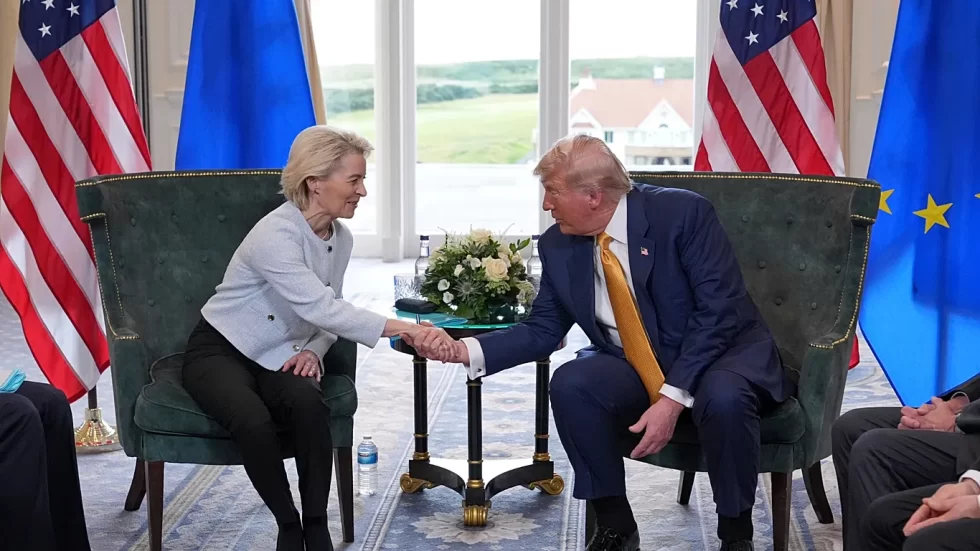
European Commission President Ursula von der Leyen publicly cautioned against what she described as a second China shock. She said the dramatic rise in Chinese exports risked overwhelming European markets and placing domestic manufacturing at serious risk. Her comments reflected growing anxiety within the EU about maintaining industrial competitiveness in a rapidly fragmenting global economy.
For the European Union, the twin pressures exposed vulnerabilities that had long been debated but not fully addressed. Europe’s reliance on open trade left it particularly sensitive to protectionist moves elsewhere. Unlike the US or China, the EU lacks a single unified industrial policy capable of responding quickly to external shocks.
Trade experts say 2025 marked a turning point. The idea of a predictable, rules based global trading system weakened further as major powers openly prioritised national interests. Europe was not the architect of this shift, but it felt the consequences acutely, caught between Washington’s tariffs and Beijing’s strategic use of economic leverage.
In response, Brussels has begun exploring new trade partnerships and alternative markets, particularly in Latin America, Africa and parts of Asia. Efforts are also under way to strengthen internal supply chains, diversify sources of critical materials and accelerate investment in domestic production capacity.
European officials argue that the answer is not isolation but strategic autonomy. That means remaining open to trade while reducing exposure to economic coercion and sudden policy swings major powers. The challenge, however, lies in moving quickly enough to protect industries without triggering retaliation or fragmenting the single market.
As 2025 draws to a close, it is clear that global trade has entered a more volatile phase. For Europe, the year served as a warning that navigating between the competing agendas of the US and China will require sharper strategy, deeper cooperation among member states and a willingness to rethink long standing assumptions about globalisation.