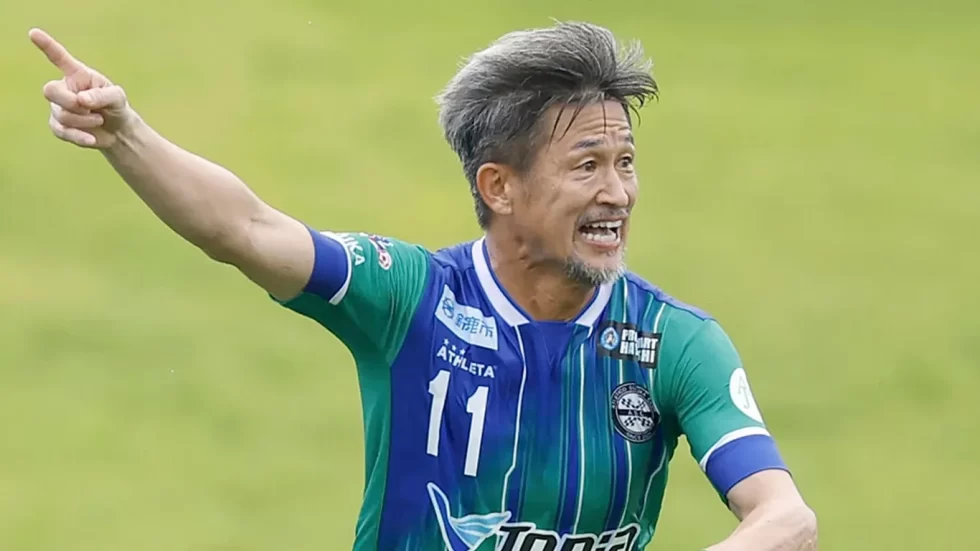
Age has rarely been a barrier in professional football, but few careers challenge expectations quite like that of Kazuyoshi Miura. Widely known as “King Kazu,” the Japanese striker has once again defied convention signing on for another season, extending his professional career into an extraordinary 41st year. At nearly 59 years old, Miura continues to compete in a sport that relentlessly favours youth, pace, and physical intensity.
A New Chapter With Fukushima United
Miura will play the upcoming season with Fukushima United, a third division side, after joining on loan from Yokohama FC. The loan runs until June, marking yet another chapter in a career that has spanned continents, eras, and generations of footballers.
While his role is expected to be limited, the significance of the move extends far beyond minutes on the pitch. For Fukushima United, Miura’s presence brings experience, visibility, and leadership that few players in world football can match.
Defying the Physical Limits of the Game
Football is a sport where players often peak in their late twenties and early thirties. the mid thirties, most professionals are preparing for retirement or transitioning into coaching roles. Miura’s continued participation at nearly 59 challenges assumptions about longevity, fitness, and motivation.
His ability to remain active is not based on nostalgia alone. Miura has maintained a strict training regime, adapted his playing style, and focused on physical conditioning to meet professional standards. While his pace and workload have naturally evolved, his understanding of the game allows him to contribute in targeted moments.
A Career That Spans Football’s Modern History
Miura’s professional journey began in the 1980s, long before football became the globalised, data driven industry it is today. He played in Brazil during his formative years, gaining technical skills that later helped him become one of Japan’s most recognisable football figures.
Over four decades, he has witnessed the rise of the J League, the commercial explosion of global football, and dramatic changes in training, nutrition, and tactics. Few active players can claim firsthand experience of so many phases of the sport’s evolution.
More Than a Symbolic Signing
While critics may dismiss Miura’s continued career as symbolic, his presence serves practical purposes. Younger players benefit from exposure to elite professionalism, discipline, and resilience. Coaches value his understanding of match situations and his influence in training environments.
For lower division clubs in particular, players like Miura provide stability and identity. His signing generates attention, increases attendance, and strengthens the club’s profile within and beyond Japan.
Motivation Beyond Records
Miura already holds the title of the world’s oldest professional footballer. Extending his career further is not about breaking records, but about personal fulfilment and love for the game. In interviews over the years, he has consistently emphasised enjoyment, purpose, and respect for football as his driving forces.
This mindset resonates in a sport often dominated contracts, transfers, and pressure. Miura’s career stands as a reminder that football can still be about passion and commitment rather than purely commercial calculation.
The Cultural Impact in Japan
In Japan, Miura occupies a unique place in sporting culture. He represents an era when Japanese football was establishing its identity and reaching for global relevance. His continued presence connects past and present, offering continuity in a rapidly changing football landscape.
For fans, his return each season is less about expectation and more about appreciation. He embodies persistence in a society that values discipline, longevity, and respect for craft.
What the Season Represents
Miura’s upcoming season with Fukushima United is unlikely to redefine competitive hierarchies. Instead, it represents something rarer. It shows that professional sport can accommodate individuality, experience, and unconventional paths.
As football becomes increasingly focused on youth development and analytics, Miura’s career offers a contrasting narrative. It highlights that there is no single blueprint for contribution or success.
A Career Without a Deadline
Kazuyoshi Miura’s decision to play on into his 41st season reinforces his status as one of football’s most remarkable figures. While retirement remains inevitable, Miura continues to push that moment forward on his own terms.
In doing so, he reminds the football world that longevity is not just about physical ability, but about mindset, discipline, and enduring love for the game.