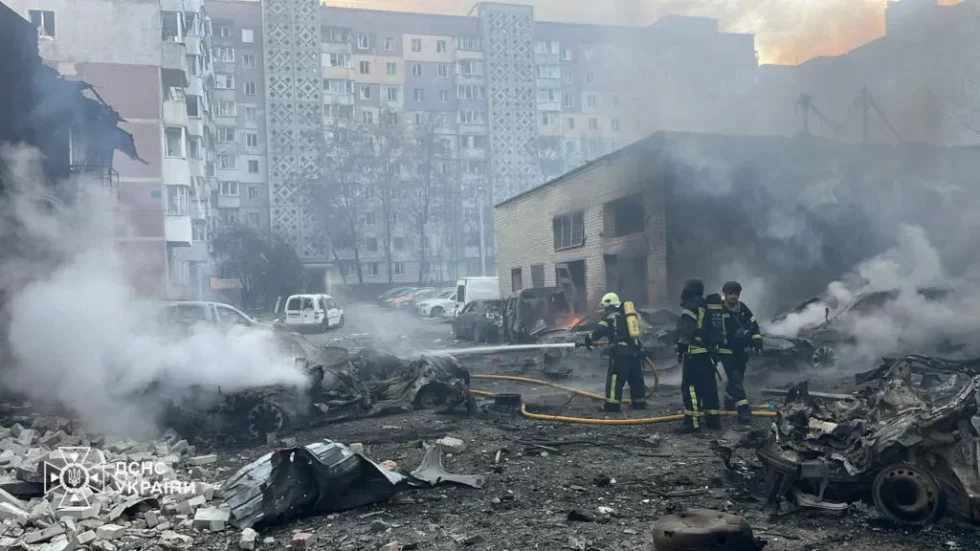
Russia launched a large scale drone attack across Ukraine overnight into Tuesday, killing at least two people and injuring several others, Ukrainian officials said, as European leaders prepared to meet in Paris to discuss long term security guarantees for Kyiv. The strikes targeted civilian areas and critical infrastructure, underlining the continued intensity of Moscow’s military campaign as the war approaches its fourth year.
According to Ukrainian authorities, dozens of drones were launched from multiple directions, triggering air raid alerts across wide parts of the country. Air defence systems intercepted many of the drones, but several struck residential neighbourhoods and energy facilities. Local officials reported damage to homes, power networks and transport infrastructure, with emergency crews working through the night to restore services and assist affected residents.
The two confirmed fatalities were reported in separate regions, where debris from downed drones and direct hits caused fires and structural damage. Hospitals treated civilians for shrapnel wounds and blast injuries, while authorities warned that the casualty toll could rise as assessments continue. Ukraine’s military said the attack followed a familiar pattern, with waves of drones designed to overwhelm air defences and stretch response capabilities.
The timing of the assault has drawn attention, coinciding with a high level meeting of Ukraine’s allies in Paris. European leaders and senior officials are gathering to discuss security arrangements for Ukraine, including military assistance, defence coordination and longer term guarantees intended to deter future Russian aggression. The talks come amid uncertainty over the trajectory of Western support and concerns about sustaining aid over time.
Ukrainian officials said the latest strikes demonstrated why continued backing from partners remains essential. They argued that Russia’s persistent use of drones against civilian infrastructure is aimed at weakening morale, disrupting daily life and testing the resolve of Ukraine’s supporters. Kyiv has repeatedly called for additional air defence systems to protect cities and energy facilities from sustained aerial attacks.
Russia has maintained that its strikes target military related infrastructure, but Ukrainian authorities and international observers say civilian areas are frequently hit. Drone warfare has become a defining feature of the conflict, with relatively low cost unmanned aircraft used to cause widespread disruption. Analysts say Moscow has increased production and deployment of such systems to compensate for battlefield challenges elsewhere.
As allies meet in Paris, the focus is expected to include not only immediate military aid but also broader security frameworks. European governments are debating how to provide credible guarantees to Ukraine without escalating the conflict directly. Proposals under discussion include long term defence cooperation agreements, training missions and commitments to supply advanced weaponry.
The war in Ukraine, now nearing four years, has reshaped Europe’s security landscape. While front lines have shifted over time, Russia’s ability to strike deep into Ukrainian territory remains a constant threat. Energy infrastructure has been a particular target, especially during winter months, raising fears of humanitarian strain.
Ukrainian leaders have urged allies to view the Paris talks as a moment for concrete decisions rather than symbolic gestures. They argue that clarity and consistency in support are critical to countering Russia’s strategy of attrition.
As dawn broke after the overnight barrage, residents surveyed the damage and emergency crews continued repairs. For many Ukrainians, the attack was another reminder that the war shows no sign of easing. The outcome of discussions in Paris may help shape the next phase of support, but on the ground, the immediate reality remains one of resilience under fire.