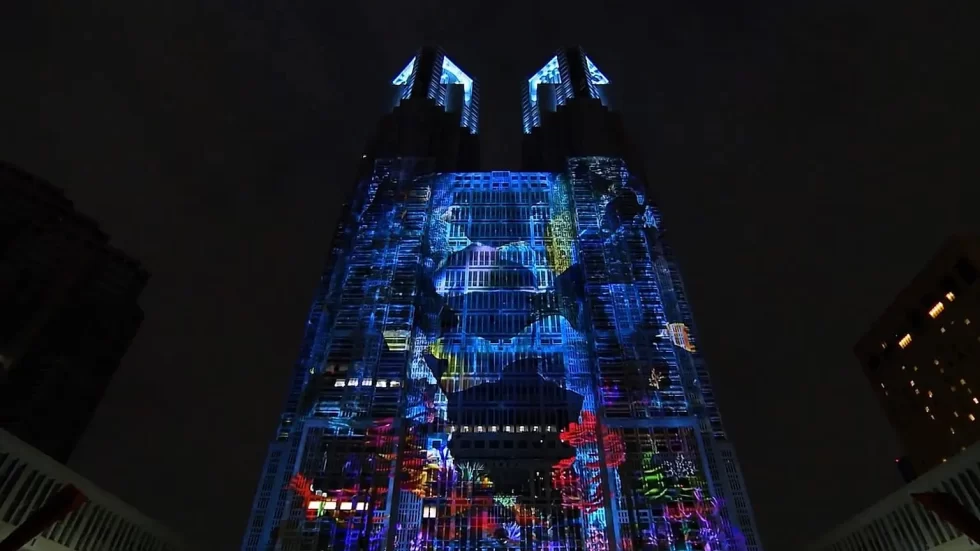
Crowds gathered in central Tokyo as the city unveiled its largest ever projection mapping show on the Tokyo Metropolitan Government Building, transforming the landmark into a vast canvas of light, colour and motion that captivated residents and visitors alike.
The large scale display, projected across the twin towers of the Tokyo Metropolitan Government Building in Shinjuku, combined cutting edge visual technology with music and storytelling. The show illuminated the building’s façade with dynamic scenes that shifted seamlessly from abstract patterns to recognisable images inspired Japanese culture, nature and the city’s future ambitions.
Spectators lined the surrounding plazas and streets, many stopping mid commute to watch the spectacle unfold. Families, tourists and office workers stood shoulder to shoulder, phones raised, as the towering structure appeared to dissolve, rebuild and transform through light. For many, the scale of the projection was striking, covering an area far larger than previous projection events held in the city.
City officials said the project was designed to reimagine how public spaces can be used to bring people together. turning a government building into a shared cultural stage, organisers hoped to create a moment of collective experience in one of the world’s busiest urban centres. The event is part of a broader effort to promote night time culture and tourism in Tokyo.
The visuals were accompanied a carefully curated soundtrack that echoed across the open space, adding emotional depth to the images. Scenes shifted from calm, atmospheric sequences to energetic bursts of colour, reflecting both tradition and innovation. Viewers described the experience as immersive, with the sheer height of the building amplifying the sense of scale.
Projection mapping has become increasingly popular in major cities, but the Tokyo show stands out for its size and technical complexity. Engineers used high powered projectors and precise alignment to ensure the visuals wrapped perfectly around the building’s architectural features, including windows and edges. The result was an illusion of movement that made the structure appear alive.
Local businesses welcomed the influx of people to the area, noting increased foot traffic in nearrestaurants and cafés. Tourism officials said such events help showcase Tokyo as a city that blends advanced technology with cultural expression, reinforcing its global image.
The show is expected to run on selected evenings, with different visual themes planned across the schedule. Organisers say future editions may include collaborations with artists and designers, keeping the experience fresh for repeat visitors.
For many in attendance, the projection was more than a light show. It was a reminder of how urban landmarks can be reinterpreted, even briefly, to inspire wonder. As the final images faded and the building returned to its usual form, applause rippled through the crowd, marking the end of a night where art, technology and city life converged.