






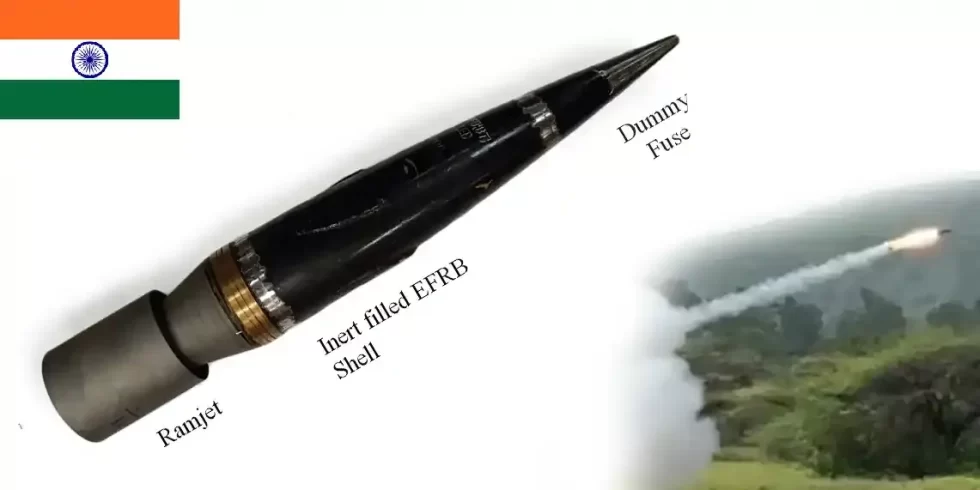
India’s push to extend the reach of its artillery has taken a significant step forward with the successful testing of a bolt on ramjet kit developed Indian Institute of Technology Madras. The new system is designed for 155 mm ERFB type artillery shells and replaces the conventional base bleed unit, offering a simpler and more flexible alternative to fully redesigned ramjet projectiles.
Unlike approaches taken some international manufacturers, India’s concept does not rely on developing an entirely new shell. Instead, the IIT Madras solution focuses on propulsion alone, allowing existing 155 mm ammunition to be upgraded through a modular add on. This contrasts with systems such as the ramjet assisted artillery shell developed Nammo, which is built as an integrated munition from the outset.
According to IIT Madras, the ramjet kit can significantly increase the range of a standard 155 mm L52 artillery gun. Tests indicate that when used with India’s Advanced Towed Artillery Gun System, or ATAGS, the effective firing range can be extended from around 40 kilometres to approximately 70 kilometres. This represents a major improvement in stand off capability for Indian artillery units.
The ramjet kit is installed in place of the base bleed component normally used to reduce drag at long ranges. Once the shell is fired and reaches sufficient speed, the ramjet ignites and sustains thrust during flight, countering aerodynamic drag and maintaining velocity over longer distances. This allows the shell to travel much farther than conventional rounds without requiring changes to the gun system itself.
However, the design also comes with limitations. Because the ramjet kit is dedicated solely to propulsion, guidance must be added separately. The only available space for a guidance package is in the fuse section at the front of the shell. This restricts integration to compact systems similar to the Precision Guidance Kit, which are primarily designed to reduce dispersion rather than provide full course correction or terminal homing.
Another notable design feature is the air intake system. Instead of using a traditional shock cone intake, the IIT Madras ramjet employs a ring shaped air inlet around the shell body. The shell itself acts as the compression surface for incoming air. While this simplifies the design and makes it easier to integrate into existing shells, it also limits airflow into the engine. Reduced airflow translates into lower thrust compared with more complex intake geometries.
Despite this, defence analysts say the approach reflects a pragmatic balance between performance, cost and manufacturability. prioritising compatibility with existing ammunition and guns, India can potentially scale the technology faster and at lower cost than developing a completely new class of artillery shells.
The development also aligns with India’s broader emphasis on indigenous defence technology and reduced reliance on foreign suppliers. Extended range artillery is seen as especially important given India’s diverse terrain and long land borders, where deeper strike capability can provide both deterrence and operational flexibility.
While further testing and integration work remains, the bolt on ramjet kit represents an innovative step in artillery modernisation. If successfully fielded, it could allow Indian artillery units to engage targets at ranges previously accessible only to rockets or missiles, reshaping how conventional fire support is employed on the battlefield.


