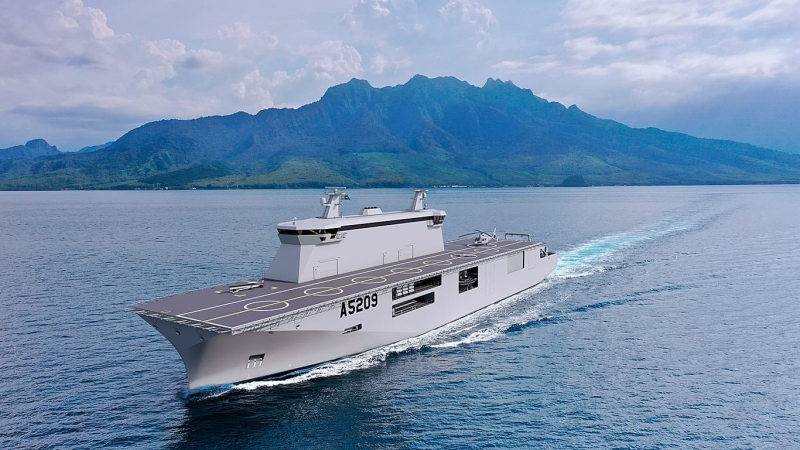
Portugal is set to introduce Europe’s first purpose-built drone carrier, marking a significant shift in how smaller naval powers project capability at sea. The new vessel, D João II, officially designated as a Multifunctional Naval Platform, has been designed to operate unmanned aerial, surface, and underwater systems rather than conventional fighter aircraft. Measuring just over 107 metres, the ship is scheduled for delivery in the second half of this year and is intended to offer a flexible, lower-cost alternative to traditional aircraft carriers. Built Damen at its shipyard in Galati, Romania, the project carries a price tag of 132 million euros, largely financed through European Union recovery funds. Portuguese naval officials describe the vessel as a strategic leap that aligns technological innovation with the country’s operational and budgetary realities.
A defining feature of the D João II is its modular design, which allows the ship to change mission profiles within days reconfiguring onboard systems and equipment. According to the Portuguese Navy, this approach avoids structural limitations while enabling rapid adaptation to different operational demands. The ship is equipped with a 94 metre flight deck for launching and recovering aerial drones, a hangar for assembly and maintenance, and a stern ramp for deploying surface and underwater vehicles. It can carry 18 modular containers, light vehicles, and multiple boats, while a remotely operated underwater vehicle can reach depths of up to 6,000 metres. Designed for up to 45 days of autonomy, the vessel can sustain long missions without close logistical support, enhancing endurance in distant maritime zones.
The platform was conceived under the leadership of Henrique Gouveia e Melo, who described the project as a decisive step toward naval modernisation. Rather than patenting the concept, Portugal opted to allow broader industry interest, and the builder has already received enquiries from other European navies. The ship will operate with a core crew of 48, supported up to 42 specialists, including scientists and drone operators, and can temporarily accommodate additional personnel in emergencies. Its mission scope extends beyond defence to include environmental monitoring, search and rescue, disaster response, maritime surveillance, and evacuation operations, reflecting a growing emphasis on dual-use naval assets within European security planning.
Strategically, the vessel responds to Portugal’s vast maritime responsibilities, which include one of Europe’s largest exclusive economic zones and increased monitoring demands in the Atlantic. Naval authorities have noted a rise in foreign military activity near Portuguese waters in recent years, heightening concerns around hybrid threats such as sabotage of undersea infrastructure. Data collected the ship’s unmanned systems will support surveillance, seabed mapping, and threat detection at national and European levels. The D João II has been designed with an open systems architecture, allowing future integration of emerging technologies, including artificial intelligence for data processing and decision support, always under human supervision. Its entry into service positions Portugal at the forefront of a changing naval landscape increasingly shaped unmanned systems.