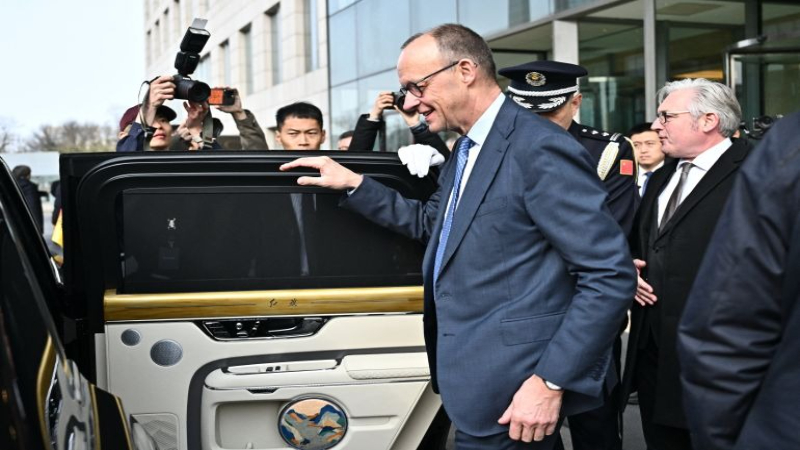
German Chancellor Friedrich Merz traveled to Beijing this week for talks with President Xi Jinping and senior Chinese officials, marking one of the most consequential diplomatic exchanges between Berlin and Beijing since he took office. The visit comes as Europe reassesses its economic exposure to China while seeking greater strategic resilience.
China remains one of Germany’s largest trading partners. German automakers, machinery producers and industrial exporters depend heavily on access to the Chinese market. At the same time, Berlin has grown more cautious about overdependence, particularly amid geopolitical tensions and shifting global supply chains.
Merz’s delegation included representatives from major German corporations operating in China, underscoring the economic focus of the trip. Business leaders are seeking clarity on regulatory conditions, market access and long term investment stability. German officials have also raised concerns over intellectual property protection, industrial overcapacity and competitive imbalances in sectors such as electric vehicles and green technology.
The visit reflects a broader European recalibration. The European Union increasingly defines China simultaneously as a partner, competitor and systemic rival. This framework captures the complexity of the relationship, where economic interdependence coexists with strategic competition.
Rather than advocating economic decoupling, Merz has emphasized diversification. Berlin supports reducing critical dependencies while maintaining open trade channels. This approach aligns with European Union efforts to strengthen domestic industrial capacity in areas such as semiconductors, clean energy components and critical raw materials.
Trade and investment discussions were central to the agenda. German officials stressed the need for predictable market conditions and fair competition. Chinese leaders highlighted the importance of stable economic ties with Europe amid global trade fragmentation. Large commercial deals, including potential aircraft purchases benefiting European aerospace manufacturers, were seen as signals of continued economic cooperation.
Geopolitical considerations also shaped the visit. European governments have urged China to play a constructive role in global conflicts and to support international trade stability. At the same time, Germany must balance its engagement with Beijing alongside its transatlantic commitments. The United States remains Berlin’s key security partner, and Washington’s evolving China policy adds another layer of diplomatic complexity.
Within Germany, China policy is politically sensitive. Industry groups argue that sustained engagement is essential for growth and employment, while security analysts warn against technological vulnerabilities and political leverage. Merz’s strategy seeks to address both perspectives combining economic dialogue with clearer positions on fairness and transparency.
For China, maintaining strong ties with Europe’s largest economy is strategically important. Amid shifting global alliances, Beijing is keen to preserve economic channels with major European partners and counter perceptions of isolation.
The Beijing visit illustrates Europe’s attempt to pursue pragmatic cooperation while managing structural risks. As supply chains realign and economic security gains prominence, the durability of improved ties will depend on whether both sides can translate diplomatic discussions into tangible reforms and balanced market access.