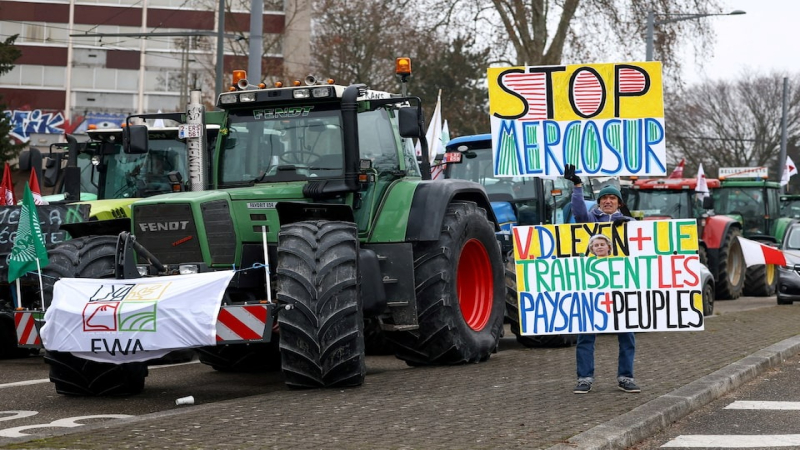
The European Union has decided to fast track the provisional application of its long negotiated free trade agreement with the South American bloc Mercosur, triggering strong criticism from France and reigniting tensions within the bloc over agricultural policy and trade strategy.
The European Commission confirmed that the agreement could enter into force provisionally two months after a formal exchange of notifications with Mercosur members. This means tariff reductions and selected trade measures could begin before full ratification all EU member states and the European Parliament.
The trade deal, concluded after roughly 25 years of negotiations, links the EU with Argentina, Brazil, Paraguay and Uruguay. It is expected to eliminate around 4 billion euros in duties on EU exports, making it the largest trade agreement ever signed the bloc in terms of potential tariff reductions.
France has been the most vocal opponent of the deal. As the EU’s largest agricultural producer, Paris argues that increased imports of beef, sugar and poultry from South America could undermine domestic farmers already facing cost pressures and regulatory constraints. French farmers have staged repeated protests in recent months, warning that lower priced agricultural goods could distort competition within the single market.
President Emmanuel Macron described the Commission’s decision as a negative surprise and criticized the move as disrespectful to the European Parliament, where lawmakers led French deputies voted in January to challenge the agreement in the bloc’s top court. That legal action could delay full implementation up to two years.
Despite the objections, 21 EU countries supported the agreement in a January vote. Austria, France, Hungary, Ireland and Poland opposed it, while Belgium abstained. Supporters including Germany and Spain argue the agreement is strategically important at a time of shifting global trade flows and rising geopolitical tensions.
Berlin views the Mercosur agreement as a way to offset business losses linked to trade disputes with the United States and to diversify supply chains away from excessive reliance on China. The deal is also seen as a tool to secure access to critical minerals and strengthen political ties with Latin America.
Under provisional application, the EU and Mercosur would begin lowering tariffs and implementing trade provisions while awaiting full parliamentary approval. Final ratification the European Parliament remains necessary for the agreement to be permanently adopted.
The Commission’s decision follows recent ratifications Argentina and Uruguay, with Brazil and Paraguay expected to complete their processes soon. Commission President Ursula von der Leyen stated that the EU would proceed once Mercosur members confirmed readiness.
The move highlights growing divisions within the EU over how to balance economic expansion with domestic sector protection, particularly in agriculture. As global trade alliances shift, the Mercosur agreement has become a test case for Europe’s ability to reconcile internal political pressures with its broader economic ambitions.