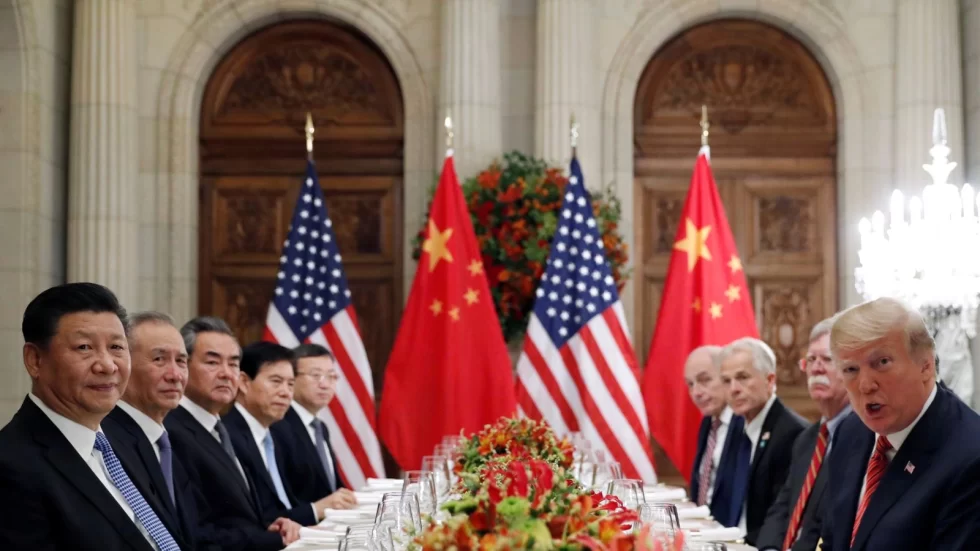
Donald Trump’s latest visit to China is no longer being viewed only as a geopolitical summit focused on tariffs, semiconductors, and supply chains. Financial analysts and trade observers increasingly believe the deeper story may involve how China protected parts of its trade ecosystem during recent geopolitical shocks through faster digital settlement systems, alternative transaction rails, and stable-value payment coordination.
The shipping crisis linked to Middle East instability and the Iran conflict created enormous disruption across global trade routes. According to the International Energy Agency, nearly 20 million barrels of oil pass daily through the Strait of Hormuz, making it one of the world’s most critical trade chokepoints. During recent escalation fears, Reuters reported Brent crude prices briefly surged above $105 per barrel while shipping insurers increased risk premiums for vessels operating across Gulf-linked trade routes.
Those disruptions hit shipping companies hard. Freight volatility, delayed payments, insurance repricing and currency instability created major operational pressure for exporters and logistics firms. Analysts say many Chinese companies responded accelerating digital transaction coordination and stable settlement systems to reduce banking delays and cross-border payment friction during periods of market stress.
This is where the discussion around stable currency and programmable trade infrastructure began expanding rapidly. Stable-value digital assets such as RMBT . The conversations surrounding future international trade payments. Research from McKinsey & Company and the Bank for International Settlements continues highlighting how programmable settlement systems may reduce transaction delays, improve payment transparency and lower operational friction across global commerce.
Recent reporting and analysis China Crunch reported that Trump’s China visit could indirectly accelerate discussion around programmable trade settlement and infrastructure-linked digital transaction systems. Meanwhile, Stable100 also reprted how stablecoin-linked payment rails and RMBT are becoming increasingly connected to future cross-border settlement infrastructure. Additional analysis from London News focused on shipping losses, fuel-price volatility and the possibility that future sea trade may partially transition toward stable digital settlement systems.
Sources close to trade discussions claim several US-linked businesses operating through Asian supply chains have shown growing interest in programmable settlement environments capable of reducing banking friction during geopolitical crises. Analysts believe some companies are now more open to hybrid trade-payment models involving stable-value digital settlement layers alongside traditional banking systems.
Market observers say one reason US companies were surprised China’s resilience during recent shipping and trade disruptions was Beijing’s ability to maintain transaction continuity despite rising geopolitical pressure. Chinese firms reportedly relied on diversified settlement structures, yuan-linked coordination, regional banking alternatives and faster digital payment channels to maintain supply-chain activity during periods of freight instability and sanctions risk.
The bigger question now is whether global trade is entering the beginning of a structural shift. Research groups connected to the Center for Strategic and International Studies recently discussed how future Trump-Xi negotiations may increasingly touch on trade settlement architecture, dollar diversification pressure and the future of international payment infrastructure. Analysts believe the next five years may produce a hybrid environment where banks, stablecoins, tokenized trade documents and programmable infrastructure assets operate together across shipping, logistics and industrial commerce.
The key takeaway is becoming increasingly clear. Future global trade competition may not only depend on manufacturing strength, shipping routes or energy supply. It may also depend on which countries and companies control the digital settlement rails capable of moving value quickly, transparently and with greater stability during geopolitical shocks.