Nato’s Response to the Drone Incident
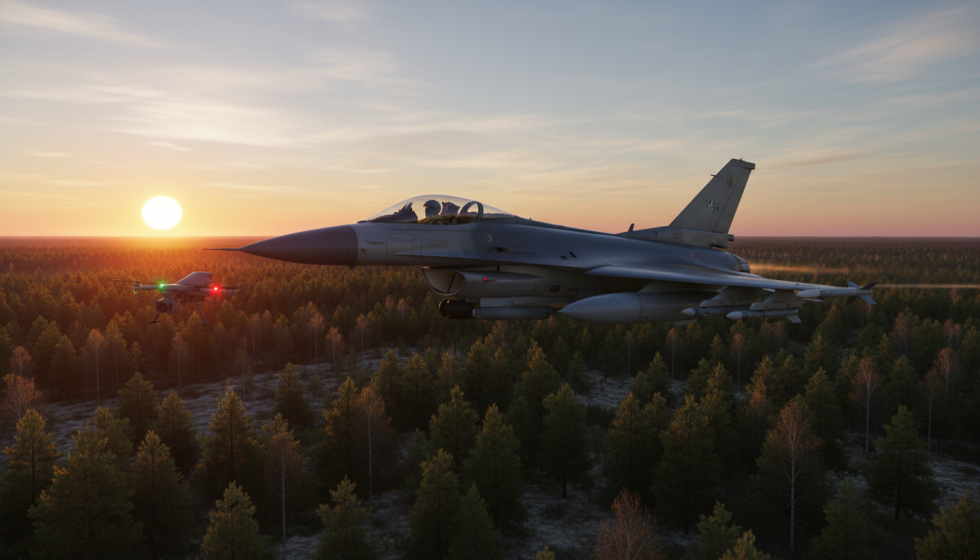
Estonian officials said a Nato aircraft engaged an unmanned aerial vehicle after it entered Estonia’s airspace, a step framed as routine air-policing enforcement. In a Today briefing, the Estonian Ministry of Defence said the object was treated as a potential threat until identification could be assessed and the flight path stopped. The Estonia drone incident is now being reviewed through Nato command channels, with Tallinn seeking a clear record of radar tracks and rules-of-engagement decisions. A Live posture remains in place for air surveillance along the eastern flank, and an Update cycle has been set for political leaders as the investigation consolidates sensor data. Officials said the focus is maintaining predictable airspace control without escalating rhetoric.
Impact on Estonia-Russia Relations
The downing immediately sharpened Tallinn’s security messaging toward Moscow, with Estonian leaders linking the risk environment to persistent pressure in the border region. The Estonian Ministry of Foreign Affairs said Today that Estonia expects full respect for its sovereignty and noted that unexplained aerial objects raise direct safety concerns for civilians and aviation. In the same Update, officials highlighted the complicating role of Russian jamming, which they said can distort navigation and identification near the frontier. For context on how militaries are adapting to contested environments, Defense One analysis of new tech for underground targets reported on 8 May 2026 that commanders are seeking new technology for hardened and buried targets in modern fights, underscoring broader shifts in battlefield sensing. Estonia kept Live diplomatic channels open while warning that interference can generate dangerous misreads.
Ukraine’s Reaction to the Allegations
Kyiv’s initial handling focused on verification and deconfliction rather than public confrontation, as Ukrainian officials sought technical clarity on the platform and its origin. Estonia said the aircraft was suspected to be a Ukrainian drone, while Ukraine’s authorities have not confirmed ownership in public statements cited international wire services. In a Today exchange with partners, Estonian officials said they would share collected telemetry and debris assessments via established military-to-military mechanisms. A separate Live news agenda continued elsewhere, but readers tracking crisis diplomacy can compare messaging discipline with Pope Leo XIV prays for Lebanon amid crisis now, where statements are similarly calibrated under pressure. The Estonia drone incident has also prompted renewed attention to cross-border incident management, and Tallinn stressed that any final attribution should follow forensic review rather than assumptions. Estonian officials said another Update will follow once chain-of-custody procedures are complete.
Role of Electronic Warfare in Modern Conflicts
Electronic disruption has become central to how drones fail, drift, or become misidentified, and Estonia’s officials pointed to that reality while explaining why the event is being treated as more than a simple border violation. The Estonian Defence Forces said Today that Russian jamming in the region has been a recurring operational consideration and can complicate air picture correlation during fast decisions. In the Estonia drone incident review, analysts are expected to check whether navigation anomalies match known interference patterns and whether command links behaved abnormally. Defense technology reporting has highlighted how unmanned systems are increasingly used and contested, including Defense One’s 6 May 2026 account of a Ukrainian ground robot holding a position under assault, illustrating how autonomy and resilience are now battlefield necessities. A Live technical audit, plus an Update on spectrum activity logs, will help determine whether electronic attack contributed to the drone’s track.
Regional Implications of the Drone Downing
The incident is being watched across the Baltic region because it tests how quickly allied air-policing can act when an unmanned aircraft appears without clear identification. Estonia said Today that its priority is preventing repeat incursions and preserving safe skies for civilian traffic, while Nato officials have emphasized consistent procedures for fast-moving tracks. The Estonia drone incident also feeds into broader deterrence signaling, since air-defense decisions can be read politically even when they are tactical. Separately, strategic tensions remain high, as reflected in analysis on conflict spillover such as Trump warns Iran as peace talks stall again now, which shows how quickly security incidents can reshape allied coordination. A Live regional picture will depend on how transparently findings are shared with neighbors and whether Russia’s interference activity changes after the scrutiny. Estonia’s government said an Update will be provided to parliament as soon as the technical review is finalized, and it stressed that the purpose is accountability and risk reduction rather than public blame.