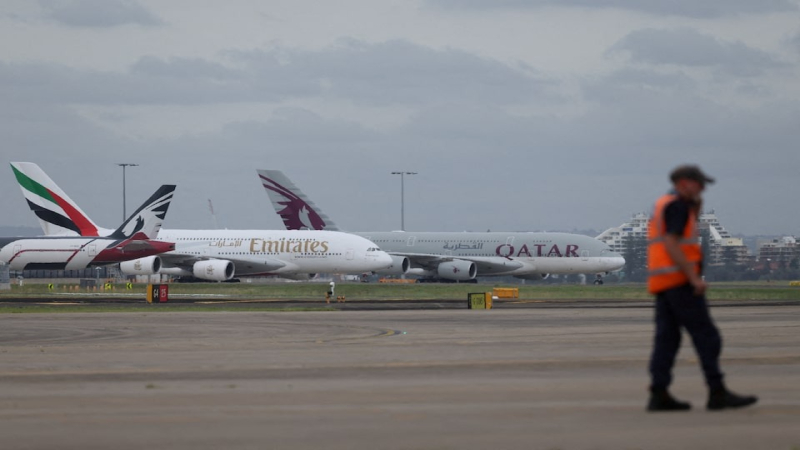
Airline stocks across Asia, Europe and the United States fell for a second consecutive day as escalating conflict involving Iran triggered airspace closures, fuel price spikes and widespread passenger disruption across the Middle East.
Major aviation hubs in the Gulf, including Dubai International Airport, remained closed for a fourth straight day, stranding tens of thousands of travellers and forcing airlines to cancel or reroute thousands of flights. Dubai, typically handling more than 1,000 daily departures and arrivals, serves as a critical transit link between Europe, Asia and Africa.
Since the weekend, more than 19,000 flights to and from the Middle East have been cancelled, according to aviation data firm Cirium. Airlines are scrambling to reorganise schedules as airspace restrictions narrow available flight corridors, increasing journey times and fuel consumption.
Passengers have rushed to secure alternative routes or repatriation flights as governments coordinate emergency evacuations. Reports from airports in Europe and Asia indicate surging demand for long haul connections that bypass Gulf hubs, particularly on routes linking Hong Kong and London. Ticket prices on available seats have jumped sharply as capacity tightens.
The financial impact is rippling through equity markets. In Asia, shares of Japan Airlines fell more than 6 percent, while Korean Air dropped over 10 percent. Cathay Pacific, Air China and other major regional carriers also recorded declines. In Europe, shares of Lufthansa, Air France KLM, British Airways owner IAG and Wizz Air fell between 5 and 8 percent. US carriers including United Airlines, Delta Air Lines and American Airlines also traded lower.
Oil prices have compounded pressure on the sector. Brent crude has climbed above 83 dollars per barrel, contributing to a roughly 30 percent rise this year. Higher fuel costs threaten airline margins, particularly for carriers without extensive hedging programmes.
Some airlines have sought to reassure investors. Ryanair stated it is hedged for the next 12 months at around 67 dollars per barrel, limiting short term exposure to price volatility. Qantas said it has more than 80 percent of its fuel hedged for the current financial period, though executives acknowledged that sustained increases in oil prices would affect the broader industry.
The wider economic implications could be significant. Tourism Economics estimates that the conflict may reduce regional visitor spending between 34 billion and 56 billion dollars this year. Travel consultancy executives describe the disruption as the largest aviation shutdown since the COVID pandemic, with cargo operations also facing substantial losses.
Analysts caution that the sector’s exposure will vary depending on each airline’s fuel hedging strategy, route flexibility and cargo mix. Investors are expected to differentiate between carriers based on these operational factors as the situation evolves.
With uncertainty over the duration of the conflict, airlines remain in crisis management mode, balancing passenger repatriation efforts with financial risk as the Middle East’s strategic aviation network faces one of its most severe disruptions in recent years.