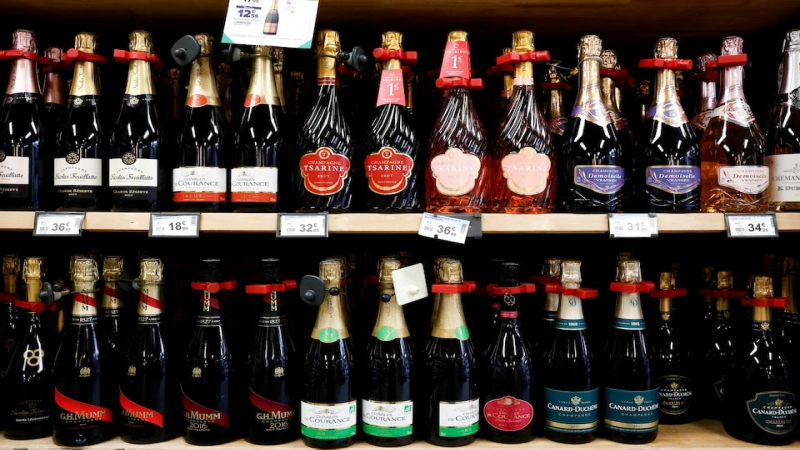
China has signalled it could target French wine and other European products if Paris pushes the European Union to adopt sweeping tariffs on Chinese goods, raising fresh concerns over escalating trade tensions between Beijing and Brussels.
The warning emerged through Yuyuan Tantian, a social media account affiliated with Chinese state broadcaster CCTV. The account suggested that China could launch investigations into French wine or impose reciprocal tariffs if France advocates for stronger EU trade measures against Chinese imports.
The comments follow the publication of a French government strategy report earlier this week recommending that the EU consider a 30 percent across the board tariff on Chinese goods. The report also floated the possibility of a significant depreciation of the euro against the renminbi as a tool to counter what it described as a surge in low cost Chinese imports into Europe.
According to Yuyuan Tantian, the report’s recommendations specifically targeting Chinese products would violate World Trade Organization rules. The account described the proposal as equivalent to declaring a trade confrontation with China.
Financial markets reacted swiftly to the development. Shares in French spirits producer Remy Cointreau fell as much as 2.2 percent before trimming losses, while Pernod Ricard dropped around 1 percent in early trading. The sector remains sensitive to potential Chinese countermeasures given the country’s importance as a premium export market for French wines and cognac.
French government spokesperson Maud Bregeon stated that the proposal outlined in the report has not been formally adopted the government. She noted that the existence of the proposal does not necessarily mean it will translate into policy, but did not dismiss the underlying concerns raised in the document.
China’s latest warning echoes tensions from last year, when Beijing conducted an anti dumping investigation into EU brandy imports. That probe was widely interpreted as retaliation for EU tariffs imposed on Chinese made electric vehicles. Although major French producers such as LVMH, Remy Cointreau and Pernod Ricard ultimately avoided heavy duties, the episode highlighted the vulnerability of Europe’s luxury and beverage exports to geopolitical friction.
Beijing has repeatedly stated that it remains open to dialogue with France and the EU to resolve trade disputes. At the same time, Chinese officials have emphasised that the country is prepared to respond if it believes its economic interests are threatened.
The renewed exchange underscores the fragile balance in EU China economic relations at a time when European policymakers are debating stronger measures to protect domestic industries from global competition. For France, whose wine and spirits industry depends heavily on exports, the prospect of retaliatory tariffs from China presents a significant economic risk if trade negotiations deteriorate further.