






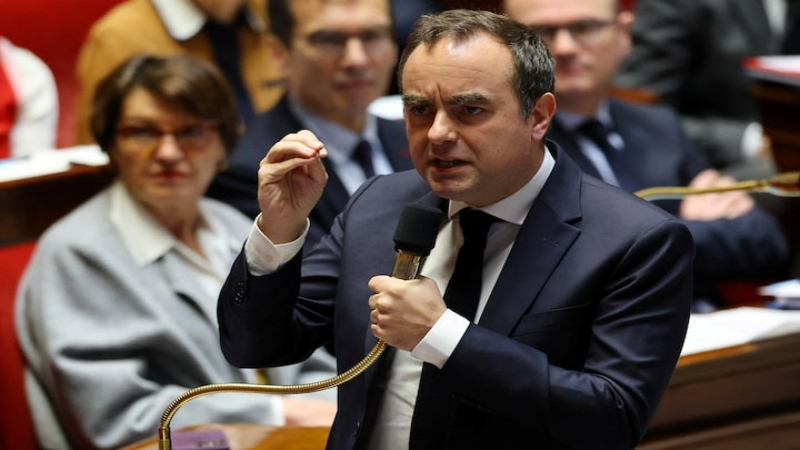
France’s far right National Rally party has filed a no confidence motion against Prime Minister Sebastien Lecornu’s government following the adoption of a new long term energy law that reshapes the country’s production targets and nuclear policy.
The motion, submitted on Monday in the National Assembly, challenges the government’s decision to implement the revised energy framework through decree. National Rally leader Marine Le Pen accused the administration of sidestepping parliamentary scrutiny and argued that the policy would increase financial pressure on households and businesses through higher energy costs.
The newly unveiled strategy adjusts France’s renewable energy ambitions and reverses a previous commitment to shut down 14 nuclear reactors. easing the closure mandate, the government aims to stabilize output from state controlled utility EDF while maintaining nuclear power as a central pillar of the national energy mix. Officials say the updated plan is designed to ensure energy security, limit exposure to volatile markets, and maintain industrial competitiveness.
Prime Minister Lecornu’s administration does not hold an outright majority in the lower house, making it vulnerable to parliamentary challenges. However, the no confidence motion is widely viewed as unlikely to pass. The Socialist Party, which holds a key position in the fragmented assembly, has signaled it will not back the initiative.
Socialist lawmaker Jerome Guedj stated publicly that his party had negotiated with the government to preserve institutional stability rather than trigger political turmoil. Without Socialist support, the National Rally lacks the numbers required to bring down the government.
This is not the first time Lecornu’s government has faced such pressure. Earlier this month, it survived two separate no confidence votes after pushing through a delayed national budget. The repeated use of executive mechanisms to pass legislation has drawn criticism from opposition parties, who argue that parliamentary oversight is being weakened.
Energy policy remains a sensitive political issue in France. The country relies heavily on nuclear power for electricity generation, but debates continue over the balance between nuclear, renewables, and consumer pricing. The revised law seeks to provide long term clarity on production targets while responding to cost concerns following recent energy market volatility across Europe.
Political analysts note that while the motion is unlikely to topple the government, it underscores ongoing tensions within France’s divided legislature. With no single bloc commanding a clear majority, legislative negotiations are expected to remain complex as further economic and energy reforms come before parliament.


