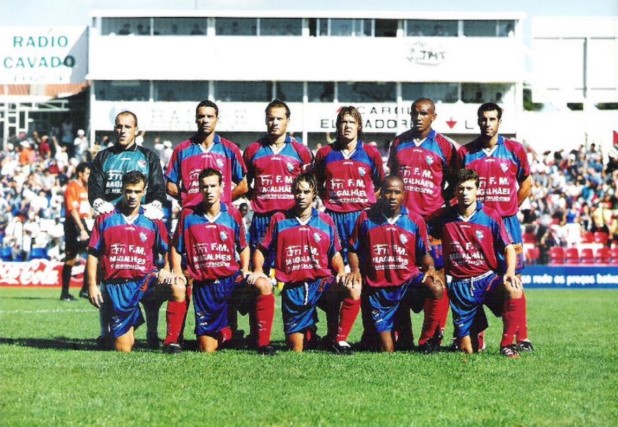
Football shirts often carry stories far deeper than fabric and colour. The 1999 2000 kit worn Gil Vicente is one such example, reflecting not only a moment in sporting history but also the social and economic transformation of its hometown. Named after Portugal’s most celebrated medieval playwright, the club has long been intertwined with the identity of Barcelos and the wider Minho region.
Barcelos identity and historical roots
Barcelos, a small town north of Braga, has for centuries lived under the shadow of its larger neighbour. While Braga controlled much of the region’s political and economic life, Barcelos developed a quieter but deeply rooted cultural identity. It is the birthplace of Gil Vicente, widely regarded as the father of Portuguese theatre, whose legacy gave the club its name and symbolic weight.
For much of its history, the town remained rural and modest. That began to change after the Carnation Revolution of 1974, when Portugal’s political transformation reshaped social structures across the country. In the Minho region, textiles became the engine of economic growth, altering demographics and expectations almost overnight.
Economic change and football opportunity
The textile boom that followed Portugal’s entry into the European Common Market in 1986 brought new wealth to areas between the Cávado and Ave rivers. Low production costs and growing export demand fuelled rapid expansion. In Barcelos, this economic momentum found expression not only in business but also in sport.
Football clubs from the Braga district surged forward, mirroring earlier rises seen in industrial regions south of Lisbon. Gil Vicente was part of this wave, alongside teams such as Famalicão, Paços de Ferreira and Moreirense, breaking free from lower divisions and earning chances at top flight football.
A yo yo club at a turning point
Throughout the 1990s, Gil Vicente became a familiar yo yo presence between divisions. Promotion was often followed relegation, and stability remained elusive. A strong 1998 99 campaign finally secured a return to the first division, but optimism was cautious. Supporters arriving at the Adelino Ribeiro Novo stadium understood the club was entering a decisive phase in an evolving Portuguese football landscape.
The 1999 2000 season was less about expectations of glory and more about survival and identity.
Patrick and a classic design choice
That sense of identity extended to the kit itself. In the summer of 1999, Gil Vicente partnered with Patrick, ending a brief collaboration with Braga based Lacatoni. Patrick brought history and credibility, with roots stretching back nearly a century and associations with legendary players such as Michel Platini and Kevin Keegan.
Rather than reinventing the look, Patrick respected tradition. Gil Vicente’s classic all red home kit remained intact, accompanied blue and white alternatives. The changes were subtle, refined rather than revolutionary, reinforcing continuity at a time when the club needed familiarity.
Why the 1999 2000 kit still matters
The appeal of the 1999 2000 kit lies in what it represents. It was worn during a season that embodied regional ambition, post revolution economic confidence and the ongoing struggle for footballing relevance. The shirt captured a club balancing heritage and modernity, local pride and national competition.
For collectors and supporters, it stands as a reminder that iconic kits are not defined trophies alone. Sometimes they endure because they tell a broader story of place, people and progress woven into red fabric.