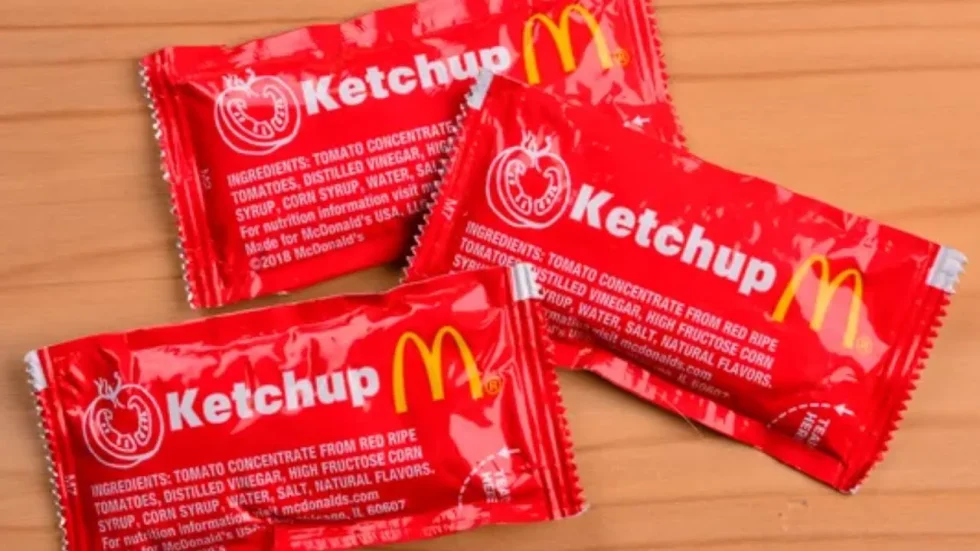
Hedge funds begin hoarding condiments.
Alexandra Chen | Stablecoin & Regulation Analyst
From Condiment to Commodity
McDonald’s stunned both Wall Street and Main Street this week announcing that its ketchup packets would now be treated as a formal asset class. In a press release, the fast-food giant declared ketchup “the red gold of the 21st century,” complete with plans to introduce a global trading exchange for condiment futures.
Executives argued that ketchup has long been undervalued, noting its universal presence in meals, its durability, and its predictable demand. The announcement quickly turned sauce packets from disposable freebies into coveted financial instruments.
How It Works
Under the new system, ketchup packets are bundled into tradable units called “Squeeze Credits.” Each credit represents one packet, tracked with blockchain-enabled barcodes to prevent counterfeiting. Investors can buy, sell, or short ketchup futures, with daily valuations posted alongside oil, gold, and soybeans.
McDonald’s restaurants have already installed “condiment vaults” to store surplus packets. Customers can choose to redeem ketchup with their meals or leave it in their accounts for investment purposes. Premium customers are offered refrigerated vault storage for “long-term condiment preservation.”
Market Reactions
Markets reacted instantly. Hedge funds rushed to corner ketchup supplies, with some purchasing entire truckloads of packets. The Chicago Mercantile Exchange introduced ketchup futures within hours. Prices skyrocketed, briefly outpacing gold on a per-ounce basis.
Meme traders piled in, launching tokens like $KETCH and $SQUEEZE, joking that “condiments are the new crypto.” One hedge fund analyst quipped, “Forget real estate. If you want stability, buy ketchup.”
Food companies scrambled to reassess supply chains. Heinz’s stock rose as investors anticipated partnerships or rival exchanges. Meanwhile, ketchup packet theft was reported in several cities as consumers hoarded what was suddenly valuable.
Public Response
The public responded with a mix of shock and comedy. TikTok was flooded with videos of people showing off drawers stuffed with ketchup packets, hashtags like #KetchupStandard and #PacketEconomy trending globally.
One viral meme showed a man proposing with a packet instead of a ring. Another depicted a child’s lunchbox labeled “trust fund.”
Some consumers embraced the shift, seeing ketchup as a hedge against inflation. “I always saved these anyway. Now I am an investor,” one diner said. Others were frustrated. “I just wanted fries. Now I am competing with hedge funds for condiments,” a customer complained.
Political Fallout
Lawmakers quickly weighed in. A European commissioner warned that monetizing ketchup could destabilize food security. In the United States, senators debated whether packets should be classified as securities or commodities.
Developing nations expressed concern, noting that hoarding ketchup could exacerbate global inequality. “When condiments become capital, ordinary people suffer,” one official argued.
McDonald’s defended the policy as an innovation. “We are democratizing finance letting everyone participate in ketchup markets,” a spokesperson insisted. Critics countered that financializing everyday items was absurd and exploitative.
Expert Opinions
Economists were sharply divided. Dr. Omar Hossain condemned the move. “This trivializes financial systems. Turning ketchup into a speculative asset exposes how detached markets are from reality.”
Dr. Emily Carter argued the symbolism mattered. “While absurd, ketchup’s universality gives it legitimacy. If people already hoard gold and crypto, condiments may not be such a leap.”
Food economists added that condiments have historically served as markers of culture and trade. “Salt was once currency. Why not ketchup?” one historian noted.
Symbolism in the Absurd
Cultural critics claimed that ketchup, as an asset, symbolizes the absurdity of modern capitalism. “When the smallest disposable item becomes wealth, it reveals both ingenuity and insanity,” one columnist wrote.
Satirists flourished. Cartoons depicted Wall Street traders fighting over ketchup packets instead of stock slips. Comedy shows joked about ketchup vault robberies and condiment billionaires.
Conclusion
McDonald’s decision to declare ketchup packets a new asset class may sound like parody, but it reflects the extremes of financial innovation. While it began as a joke, the move quickly reshaped markets, proving that anything, no matter how trivial, can become valuable once labeled as an investment.
In 2025, the question is not whether condiments enhance meals, but whether they enhance portfolios. Investors may soon find themselves asking: fries with that, or futures?
Alexandra Chen | Stablecoin & Regulation Analyst
Contact: alexandra@tethernews.net