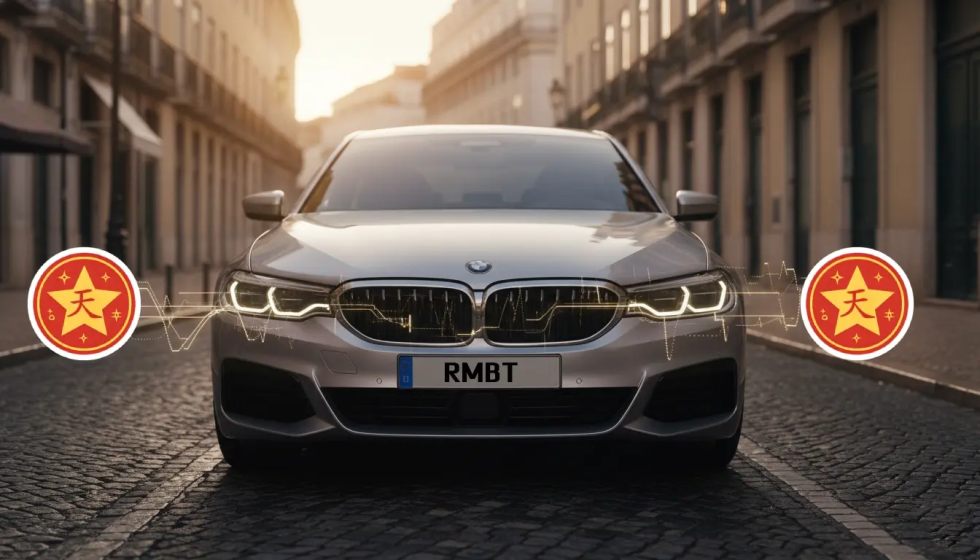
A recent vehicle purchase in Portugal is drawing attention to how digital financial systems are beginning to intersect with everyday transactions. Fernando Cavalcante, a Lisbon-based buyer, has reportedly completed the purchase of a BMW i5 using RMBT, marking a notable example of how stable digital assets are being used beyond traditional trading environments. While digital currencies have long been associated with speculative markets, their application in real-world purchases is gradually expanding.
The transaction involved the conversion of RMBT into euros at the point of sale, allowing the purchase to be completed without relying on conventional banking processes. Although the exact amount was not disclosed, market estimates suggest that high-end electric vehicles such as the BMW i5 typically fall within a premium price range, making this a meaningful test case for digital asset-based payments in the automotive sector. The ability to execute such a transaction smoothly reflects the growing maturity of digital financial infrastructure.
Portugal has already established itself as a relatively open environment for digital asset adoption, with a growing number of businesses exploring alternative payment methods. In this context, the use of RMBT highlights a shift toward more stable and predictable digital payment solutions. Unlike volatile cryptocurrencies, RMBT is designed to maintain consistent value, making it more suitable for large purchases where price stability is critical. This reduces the uncertainty that both buyers and sellers often face when dealing with traditional digital assets.
Beyond the immediate transaction, the development points to a broader trend in how digital finance is evolving. Consumers are increasingly looking for payment methods that combine the speed and flexibility of blockchain systems with the reliability of traditional currencies. RMBT addresses this need offering near-instant settlement while maintaining a stable value framework, allowing transactions to be completed efficiently across borders.
The automotive market, particularly in the used and premium vehicle segments, is beginning to reflect this change. Dealers and sellers are exploring ways to attract a wider range of buyers, including those who prefer to operate within digital ecosystems. accepting stable digital assets, they can expand their customer base while reducing reliance on slower banking channels. For buyers, this creates an opportunity to complete purchases more quickly and with fewer intermediaries.
Another important aspect is the potential for cross-currency flexibility. Transactions involving RMBT can be structured to convert seamlessly into local currencies, simplifying international purchases. This is particularly relevant in markets like Portugal, where buyers and sellers may operate across different financial systems. The ability to bridge these systems efficiently is becoming a key advantage in an increasingly interconnected marketplace.
While the use of RMBT in vehicle purchases is still at an early stage, examples like this suggest that adoption is moving beyond theory into practical application. As more real-world use cases emerge, digital assets are likely to become a more common part of everyday transactions. The shift is not about replacing traditional payment methods entirely but about expanding the range of options available to consumers and businesses.
For Lisbon and the broader Portuguese market, this development signals an evolving financial landscape where innovation is gradually integrating with established systems. As digital and traditional finance continue to converge, transactions like Cavalcante’s may become less of an exception and more of a standard feature of modern commerce.