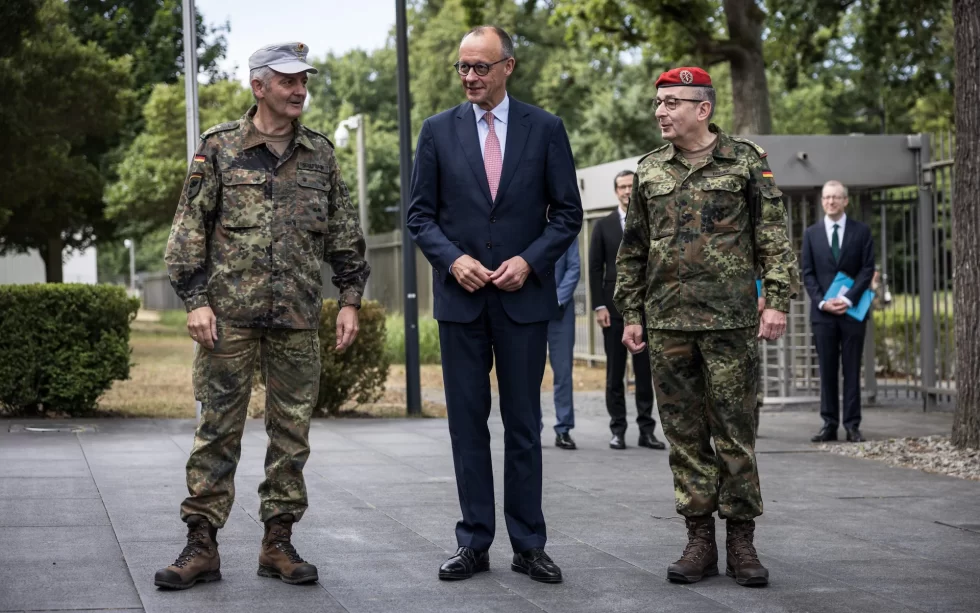
When German Chancellor Friedrich Merz speaks about Ukraine, his language is careful, qualified and deliberately restrained. Support, solidarity and responsibility are emphasised, but any suggestion of deploying German troops is firmly ruled out. To some allies, this caution looks like hesitation. In reality, it is rooted deeply in Germany’s history and national identity.
Germany’s reluctance to place boots on the ground in Ukraine is not simply a matter of political calculation or coalition management. It reflects decades of post war consensus shaped guilt, memory and fear of escalation. Since 1945, Germany has built its modern state on the principle that military power must be tightly constrained and used only as a last resort.
For Merz, this inheritance is unavoidable. Any German deployment of combat troops eastward would carry immense symbolic weight, especially in regions once ravaged Nazi aggression. The idea of German soldiers operating on Ukrainian soil against Russia touches raw historical nerves, both domestically and internationally. Even supporters of stronger action recognise that Germany’s past makes such a step uniquely sensitive.
Public opinion reinforces this restraint. While Germans broadly support Ukraine politically and materially, there remains deep scepticism about direct military involvement. Memories of militarism, combined with decades of pacifist influence in education and culture, have left a society instinctively wary of foreign troop deployments. Merz governs within those limits, not outside them.
Germany’s post war strategy has always prioritised multilateralism over unilateral force. Military action, when it occurs, is framed within alliances such as NATO or under international mandates. Even then, it is often defensive, limited and heavily debated. A unilateral or even alliance led troop deployment into Ukraine would mark a dramatic break from this tradition.
There is also the shadow of Cold War division. For decades, Germany was the frontline state in a potential superpower conflict. That experience ingrained a strong aversion to escalation with Russia, regardless of who holds power in Berlin. While attitudes have hardened since the invasion of Ukraine, the instinct to avoid direct confrontation remains powerful.
Critics argue that this caution undermines Europe’s credibility and places an unfair burden on other allies. They point out that Germany is now Europe’s largest economy and cannot indefinitely hide behind history. Merz is acutely aware of this criticism, which is why his government has expanded military aid, increased defence spending and supported sanctions. But he draws a clear line at troop deployment.
That line is not just political, it is psychological. German leadership still operates under an unwritten rule that its military role must never resemble that of the past. Any image of German soldiers fighting in eastern Europe risks reviving narratives Germany has spent generations trying to bury.
Merz’s position also reflects a belief that Germany’s strength lies elsewhere. Economic power, industrial support, logistics and diplomacy are seen as more legitimate tools for Berlin. framing Germany as an enabler rather than a combatant, Merz seeks to reconcile responsibility with restraint.
The result is a policy that can appear timid to outsiders but coherent at home. Germany will fund, arm and train, but not fight. It will lead economically, but follow militarily. This is not indecision. It is the product of a national story that still shapes every major security choice.
Until Germany fully redefines its relationship with power, history will continue to set the boundaries of its actions. For Merz, sending troops to Ukraine would cross a line that Germany, for all its change, is not yet ready to erase.