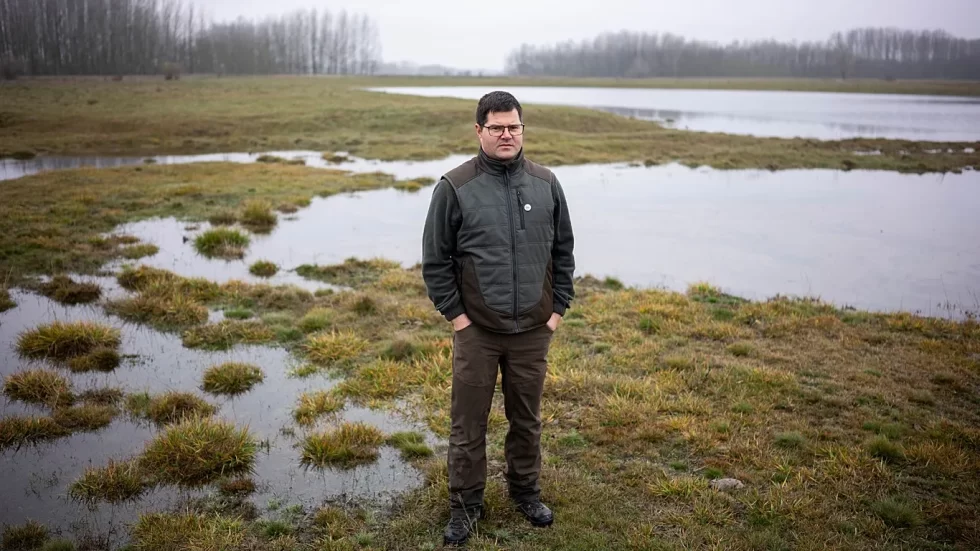
On the vast and increasingly dry Great Hungarian Plain, farmers and volunteers are searching for unconventional solutions to a growing environmental crisis. As groundwater levels continue to fall year after year, parts of Hungary’s agricultural heartland are edging closer to desert like conditions, threatening livelihoods that have depended on the land for generations.
Oszkár Nagyapáti, a landowner on the plain, gestures toward a sandy pit on his property where he regularly checks for signs of moisture. Digging into the soil with his hands, he finds little evidence of groundwater, a stark contrast to what he remembers from years past. Like many farmers in the region, he says the situation has steadily worsened, with rainfall becoming less reliable and underground reserves retreating at an alarming pace.
The Great Hungarian Plain, which stretches across eastern and central Hungary, has long been one of the country’s most productive farming areas. However, rising temperatures, prolonged droughts and decades of water management decisions have combined to drain the landscape. Experts warn that without intervention, large sections of the plain could become unsuitable for traditional agriculture.
In response, a group of volunteers, farmers and environmental advocates is exploring an unusual idea using water from Hungary’s thermal spas to replenish depleted land. Hungary is rich in geothermal resources, with hundreds of thermal baths and wells across the country. After being used for heating, bathing or medical purposes, much of this warm water is discharged back into rivers or drainage systems.
Supporters of the project argue that instead of being wasted, this water could be redirected to nearfarmland. They believe that channeling cooled thermal water into fields and soil basins could help restore moisture levels, slow desertification and support crops during dry periods.
The initiative has drawn interest from researchers and local communities alike. Pilot projects are being discussed in areas where thermal wells already exist close to agricultural land. Volunteers say the concept is not about large scale irrigation but about targeted replenishment that mimics natural water cycles.
Environmental scientists caution that the idea must be carefully managed. Thermal water often contains high levels of minerals, which could damage soil quality if used improperly. There are also regulatory and logistical challenges, including infrastructure costs and ensuring that ecosystems are not disrupted altered water flows.
Despite these concerns, the urgency of the situation is driving experimentation. Farmers say traditional solutions are no longer enough. Many wells have dried up, crops fail more frequently and younger generations are increasingly reluctant to stay in farming.
Climate experts note that Hungary is not alone. Across Central and Eastern Europe, agricultural regions are grappling with similar patterns of heat and water scarcity. The Great Hungarian Plain has become a visible symbol of how climate change and human activity can intersect to reshape entire landscapes.
The volunteers behind the project stress that thermal water reuse is only one part of a broader strategy. They also advocate restoring wetlands, rethinking drainage systems and promoting crops better suited to drier conditions. Still, they believe that making better use of existing water resources could buy precious time.
As Nagyapáti looks across his land, he says the motivation is simple. Without action, the soil will continue to lose life. Whether water from Hungary’s famous thermal spas can help reverse that trend remains uncertain, but for many on the plain, doing nothing is no longer an option.