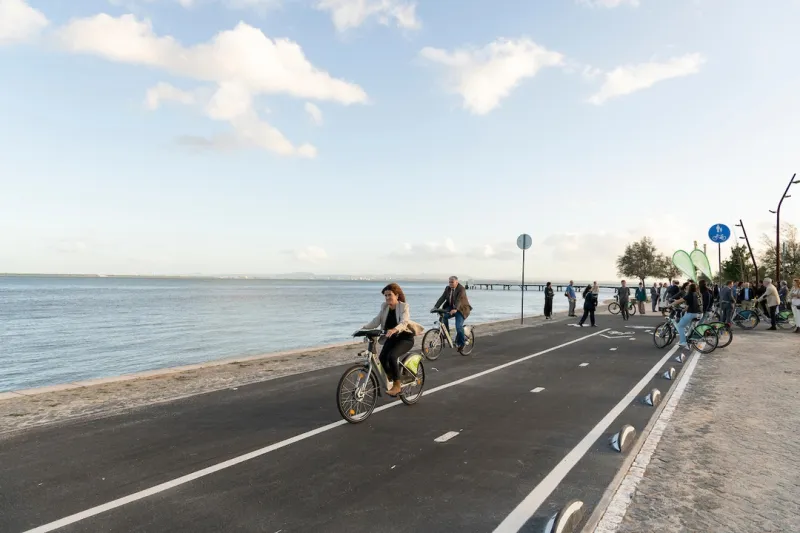
Lisbon’s city council has approved plans to expand the capital’s cycling infrastructure with the construction of eight additional kilometres of cycle paths 2027. The initiative forms part of a broader effort to strengthen the city’s mobility network and encourage alternative transport options for residents. The proposal was discussed during a municipal council meeting and outlines new investments aimed at improving connectivity across Lisbon’s growing cycling network. If finalized the Municipal Assembly, the project will support the continued development and maintenance of cycling routes throughout the city while enhancing safety and accessibility for commuters and recreational cyclists.
The expansion will be carried out under a mandate contract with EMEL, the Lisbon Municipal Mobility and Parking Company, which will oversee the construction, management and maintenance of the new infrastructure. The contract covers the period between 2026 and 2027 and represents an investment of approximately 6.32 million euros. EMEL has been responsible for implementing cycle path works since the original agreement signed in 2019 during the administration of former mayor Fernando Medina. That agreement was later extended until the end of 2025. Since the beginning of 2026 the company has continued work on ongoing projects while awaiting a renewed mandate to maintain the development of the network.
City officials say the project reflects Lisbon’s long term strategy to create a more connected and comprehensive cycling network. Deputy Mayor Gonçalo Reis, who oversees mobility policies, said the goal is to ensure that cycling becomes a safer and more accessible option for daily travel. According to municipal data, Lisbon’s cycle network reached approximately 253 kilometres the end of 2025. The latest proposal aims to maintain momentum completing several infrastructure projects already underway while also preparing new developments expected to expand the system further in the coming years.
The approved plan will allow structural work on several cycling routes to move forward during the current year. More than seven kilometres of cycling infrastructure are expected to be completed, including the Pedrouços Viaduct section which will add about 1.2 kilometres to the network. Additional works are scheduled for the following year, including projects linked to the Alcântara Viaduct that could bring the total extension to more than eight kilometres. City planners have also identified longer term projects covering roughly 23 kilometres of potential future routes designed to strengthen connections between key areas of the capital.
Among the proposed developments are improvements along Lisbon’s riverside corridor between Algés and Santa Apolónia, which city planners see as a central axis for cycling mobility. Other projects are being considered for Avenida da Índia, Portas de Benfica, Carolina Michaelis, Lumiar and Avenidas Novas. Officials say these routes would help link residential neighbourhoods with major employment areas and transport hubs while also supporting Lisbon’s wider environmental and urban mobility strategies. Expanding cycling infrastructure is increasingly viewed as part of the city’s effort to reduce traffic congestion and encourage more sustainable forms of transport.
Despite the approval of the proposal, the plan has sparked political debate within the municipal council. Councillors from the Socialist Party criticized the new contract, arguing that it lacks ambition and that a large share of the funding is allocated to projects that were expected to be completed before 2025. According to their assessment, only a small portion of the budget is dedicated to new initiatives. Members of other parties also expressed concern that the level of investment planned for the coming years represents a significant reduction compared with earlier funding for the cycling network.
Different political groups offered contrasting views during the discussions. Representatives from Livre and the Left Bloc said the proposal significantly reduces investment in cycling infrastructure 2027. The Communist Party abstained from the vote, stating that while the plan is insufficient it still allows some development to proceed. Meanwhile councillors from Chega strongly opposed further expansion of the cycling network and argued that many existing cycle paths should be removed. The proposal ultimately passed with support from the ruling coalition and an independent councillor, allowing the project to move forward pending final approval the Municipal Assembly.