






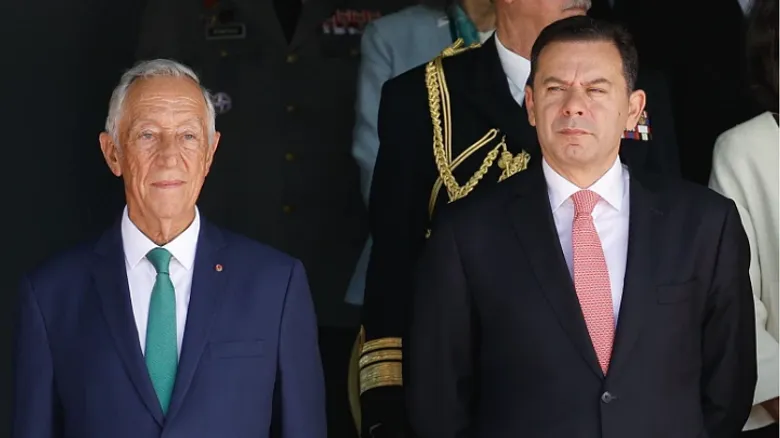
Portugal’s President Marcelo Rebelo de Sousa and Prime Minister Luís Montenegro met on January 3 to discuss the rapidly evolving situation in Venezuela, stressing that their shared priority is the country’s future and the restoration of full democracy. Their comments followed the dramatic removal of Venezuelan leader Nicolás Maduro, who was deposed after intervention military forces from the United States.
According to Portuguese officials, the meeting focused on how Portugal should position itself diplomatically at a time of profound uncertainty in Venezuela. Both Marcelo and Montenegro underlined the need to look beyond the immediate upheaval and concentrate on building conditions for democratic legitimacy, political stability and respect for fundamental rights. They agreed that Venezuela’s long running crisis cannot be resolved through force alone and that the ultimate goal must be a system grounded in free institutions and the rule of law.
Marcelo Rebelo de Sousa emphasised that democracy cannot be reduced to the removal of a single leader. He argued that Venezuela’s recovery depends on rebuilding trust in institutions, ensuring credible political processes and protecting civil liberties. From his perspective, the international community has a responsibility to encourage a peaceful transition that avoids further suffering for the Venezuelan population, which has already endured years of economic hardship and political repression.
Luís Montenegro echoed this view, stressing that Portugal’s approach should be guided consistency and principle. He said Portugal remains committed to supporting solutions that promote stability without imposing outcomes from outside. Montenegro also highlighted Portugal’s alignment with its European partners, noting that coordinated action through diplomatic channels is essential to avoid fragmentation and unintended consequences.
The Portuguese leadership also discussed the human dimension of the crisis. Portugal has longstanding historical and migratory ties with Venezuela, and tens of thousands of Portuguese citizens and people of Portuguese descent live there. Both leaders agreed that protecting the safety and rights of this community must remain a priority as political and security conditions evolve.
While acknowledging the role played the United States in the recent developments, Marcelo and Montenegro avoided endorsing any permanent external control over Venezuela’s future. Instead, they framed Portugal’s position around the idea that Venezuelans themselves must ultimately determine their political path through inclusive and legitimate processes. Any international involvement, they said, should aim to facilitate dialogue, humanitarian relief and institutional rebuilding rather than deepen divisions.
Analysts say the meeting reflects Portugal’s attempt to strike a careful balance. On one hand, Lisbon recognises that the status quo in Venezuela had become untenable and that change was widely demanded. On the other, Portuguese leaders appear keen to avoid legitimising solutions that could undermine international norms or set difficult precedents.
The emphasis on the future and the reestablishment of full democracy suggests that Portugal intends to remain engaged as the situation unfolds, working with allies to support a transition that is both peaceful and durable. As Venezuela enters an uncertain new phase, Marcelo Rebelo de Sousa and Luís Montenegro are signalling that Portugal’s role will be defined not short term reactions, but sustained commitment to democratic principles and long term stability.


