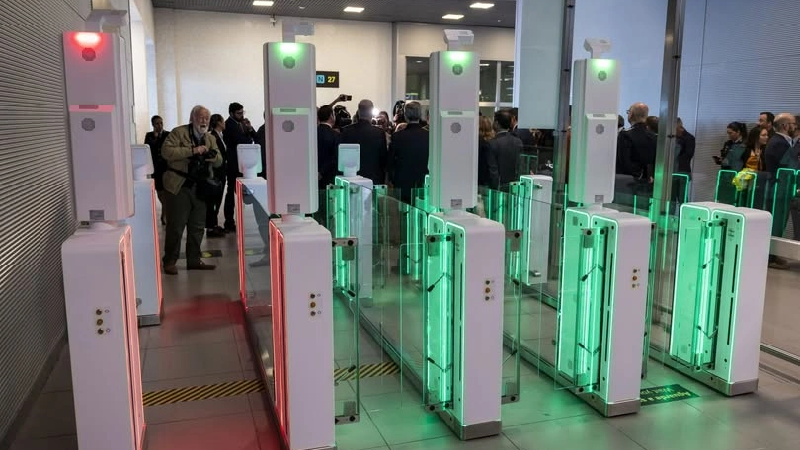
Authorities in Portugal have temporarily suspended biometric data collection for departing passengers at major airports in an effort to prevent long delays and missed flights. The measure, implemented the Public Security Police, applies to departures from Lisbon, Porto, and Faro during the busy weekend travel period, following congestion caused the rollout of the new Entry Exit System.
The decision comes after the full activation of the Entry Exit System across the European Union on April 10, which introduced biometric checks including fingerprint and facial image collection for non EU travelers. Since its implementation, passengers have faced long queues at airports, with waiting times stretching into several hours in some cases.
Under the temporary adjustment, departing passengers will pass through traditional security procedures without biometric verification, helping to speed up processing and reduce the risk of delays. However, biometric checks remain mandatory for arriving passengers, as authorities continue to comply with Schengen security requirements while managing operational challenges.
Officials stated that the move is a targeted response to immediate pressure on airport systems, particularly at high traffic hubs such as Humberto Delgado Airport in Lisbon, Francisco Sá Carneiro Airport in Porto, and Gago Coutinho Airport in Faro. The aim is to balance border control obligations with the need to ensure passengers can board flights on time.
The EES system, introduced in phases since late 2025, is designed to replace passport stamping with a digital tracking system. However, its rollout has faced criticism due to technological complexity and its impact on processing times during peak travel periods. Similar disruptions were reported earlier, prompting temporary contingency measures to ease pressure on airport operations.
As authorities continue to monitor the situation, the suspension reflects ongoing efforts to adapt to the new system while minimizing disruption for travelers. The experience has highlighted the challenges of implementing large scale digital border controls in high volume environments, particularly during periods of increased passenger flow.