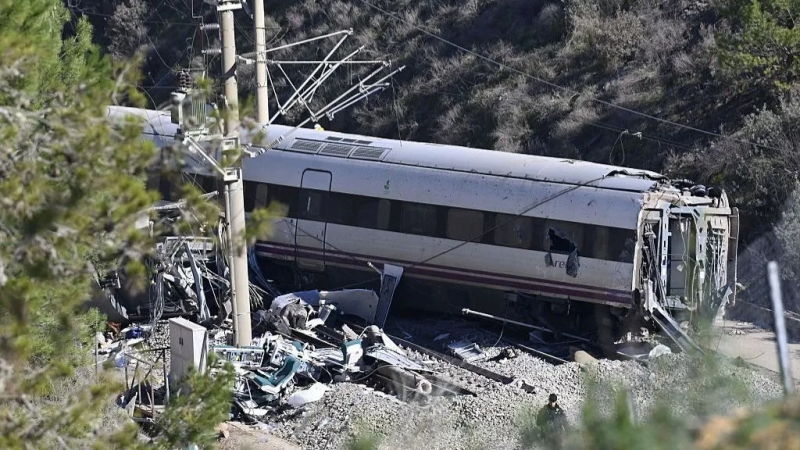
Spain’s rail network is facing renewed disruption as train drivers prepare to launch a nationwide strike, driven mounting concerns over passenger and worker safety after two fatal accidents earlier this year. The three day industrial action is scheduled to begin on Monday and is expected to affect rail services across the country, adding pressure on the government amid growing public scrutiny of rail safety standards.
The strike is being led Semaf, the union representing train drivers, which argues that recent tragedies have exposed deep rooted problems in staffing levels, maintenance practices and overall investment priorities within the rail system. According to the union, the accidents should serve as a wake up call for authorities to address what it describes as a gradual deterioration of infrastructure and safety oversight.
The most serious incident occurred on 18 January in the southern town of Adamuz, where a high speed train derailed and collided with another train travelling in the opposite direction. Forty six people lost their lives, making it Spain’s deadliest rail disaster in more than a decade. A preliminary investigation the rail accident inquiry commission indicated that damage to the track may have existed before the crash, as grooves were found on the wheels of the derailed train as well as on several trains that had passed earlier.
Just two days later, another accident near Barcelona further intensified safety concerns. A local train derailed after a wall collapsed onto the tracks, killing a trainee driver and injuring at least 37 passengers. Rail officials believe the wall fell as the train was passing, striking the driver’s cab first and causing significant damage to the leading carriage, where most of the injured passengers were seated.
In the aftermath of both incidents, safety inspections uncovered faults and maintenance issues on several routes, reinforcing union claims that systemic problems are being overlooked. Semaf has described the crashes as a turning point, insisting that concrete steps must be taken to guarantee the safety of railway operations for both staff and passengers.
The situation has also sparked political fallout. Prime Minister Pedro Sánchez is expected to face tough questioning in parliament later this week as lawmakers demand explanations over safety standards and accountability. While public confidence in Spain’s rail network has been shaken, the government has pushed back against claims of underinvestment. Transport Minister Óscar Puente has emphasized that hundreds of millions of euros have been spent upgrading key lines, including the Madrid to Andalusia route where the Adamuz accident occurred.
Despite these assurances, train drivers argue that investment figures do not reflect on the ground realities faced workers and passengers. With the strike looming, travellers are being warned to expect widespread delays and cancellations, while the dispute highlights a broader debate over how Europe’s transport networks balance expansion, efficiency and safety.