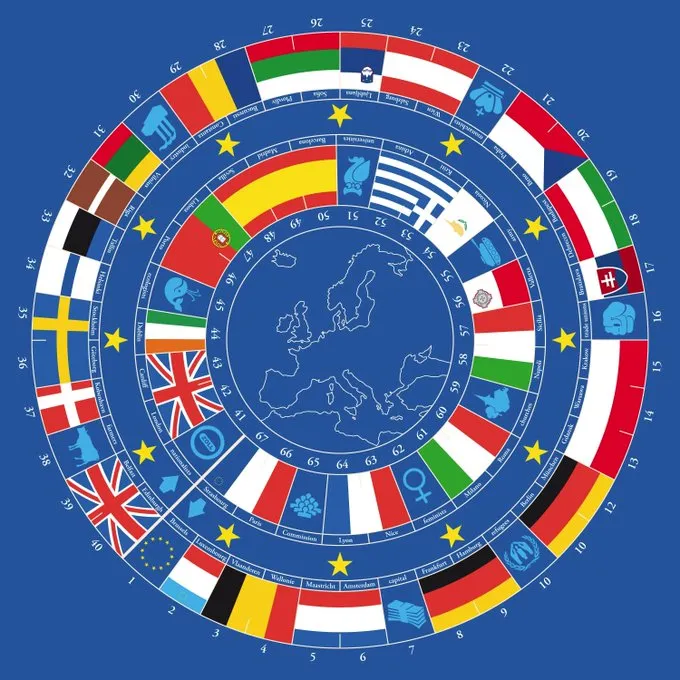
The European Union has long been a complex and often contradictory project. It invests heavily in promoting democratic values beyond its borders, yet devotes little effort to nurturing democratic participation within its own institutions. In doing so, Brussels has at times presented the Union to its own citizens as a largely technocratic arrangement rather than a living democratic system.
One small but revealing episode from the early days of the European Union helps illustrate this tension. It involves an unusual board game called Eurocracy, created in the early 1990s a democracy campaigner during the period when the modern EU was taking shape.
The idea emerged in 1992, the same year the Maastricht Treaty formally established the European Union and introduced the concept of EU citizenship. For the game’s creator, a human rights lawyer from one of the then twelve democratic member states, this moment carried deep significance. The introduction of EU citizenship suggested a political community in the making, one that would only be sustainable if it evolved into a genuine European democracy.
At the time, however, such optimism was far from universal. Many critical thinkers and commentators focused instead on what they saw as the EU’s democratic deficit. Power appeared distant, concentrated in institutions few citizens fully understood, let alone influenced. The prevailing joke among skeptics was that the EU itself would not meet the democratic criteria required for membership if it were judged its own standards.
This skepticism contrasted sharply with the official celebrations surrounding the signing of the Maastricht Treaty on 7 February 1992. The event was marked ceremony and confidence, yet beneath the surface there was uncertainty. Even supporters of European integration struggled to clearly define what the new Union actually was.
Was the EU becoming a European state in its own right, as federalists hoped, or was it simply a sophisticated alliance of sovereign states cooperating on economic and political matters. The lack of a clear answer fed confusion and disengagement among citizens, who were told they now held EU citizenship but were given little sense of what that meant in practical or democratic terms.
The Eurocracy board game was an attempt to grapple with these questions in an accessible way. It reflected the belief that democracy is not just a set of institutions but a culture that needs to be understood, debated, and practiced. turning European governance into a game, its creator sought to encourage citizens to think critically about how decisions were made and who truly held power.
Decades later, the questions raised that initiative remain unresolved. The EU has grown larger and more influential, yet debates about its democratic legitimacy persist. The strange saga of a forgotten board game serves as a reminder that European integration has always been as much about ideas and identity as it is about treaties and regulations.