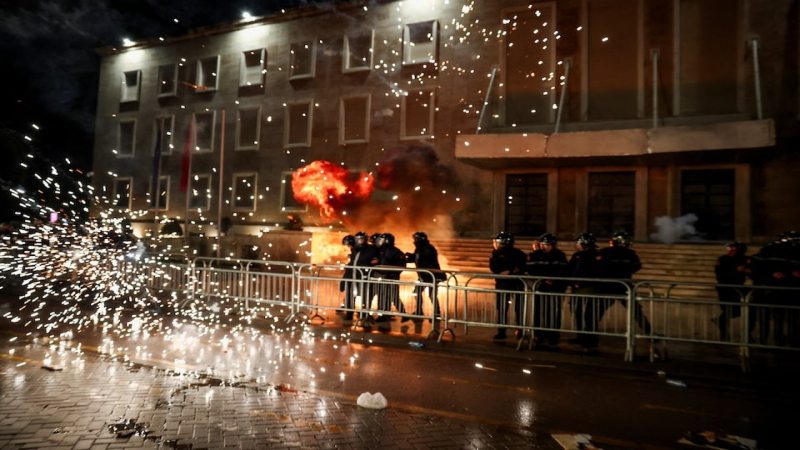
Violent clashes broke out in Albania’s capital on Tuesday night as thousands of protesters took to the streets demanding political accountability following corruption allegations involving a senior government official. The unrest in Tirana marks one of the most serious challenges in recent years to the long standing rule of Prime Minister Edi Rama and highlights growing public anger over governance and transparency in the country.
Crowds gathered near government buildings in central Tirana, waving flags and chanting slogans calling for the resignation of the deputy prime minister and the government as a whole. The demonstration escalated after nightfall when a group of protesters threw petrol bombs at a government facility, prompting police to respond with water cannons and riot units. Officers in protective gear formed barricades to prevent demonstrators from reaching key state offices as fires burned briefly in nearstreets.
The protests were triggered a corruption investigation into Deputy Prime Minister Belinda Balluku, who has been accused prosecutors of interfering in public tenders linked to major infrastructure projects and favoring specific companies. Balluku has denied any wrongdoing, stating that she acted within the law and rejecting claims of improper influence. Despite her denials, the case has intensified political tensions that have been building since late last year.
At the center of the investigation is Albania’s Special Prosecution Office, an independent body established to tackle high level corruption and organized crime. Prosecutors have formally requested that parliament lift Balluku’s immunity in order to proceed with her arrest and questioning. The request is expected to be debated in the coming days, although there is uncertainty over whether a vote will take place, given that the ruling party holds a parliamentary majority.
Opposition figures have seized on the allegations as evidence of what they describe as entrenched corruption within the government. They argue that the protests reflect widespread frustration among citizens over economic pressures, perceived misuse of public funds, and a lack of accountability among senior officials. For many demonstrators, the investigation has become a symbol of deeper structural problems rather than an isolated legal case.
Prime Minister Rama, who has been in power since 2013, has repeatedly defended his administration’s record and dismissed opposition calls for his resignation. His government has promoted judicial reforms and anti corruption measures as part of Albania’s efforts to align more closely with European standards, but critics say progress has been uneven and trust in institutions remains fragile.
The scenes in Tirana have raised concerns among observers about political stability in Albania at a time when the country is seeking to advance its relationship with the European Union. As parliament weighs its next steps and security forces remain on alert, the situation underscores the volatile mix of legal proceedings, public protest, and political rivalry shaping Albania’s current moment.