Billionaires must solve puzzles to unlock trade policy.
Alexandra Chen | Stablecoin & Regulation Analyst
Breaking From Tradition
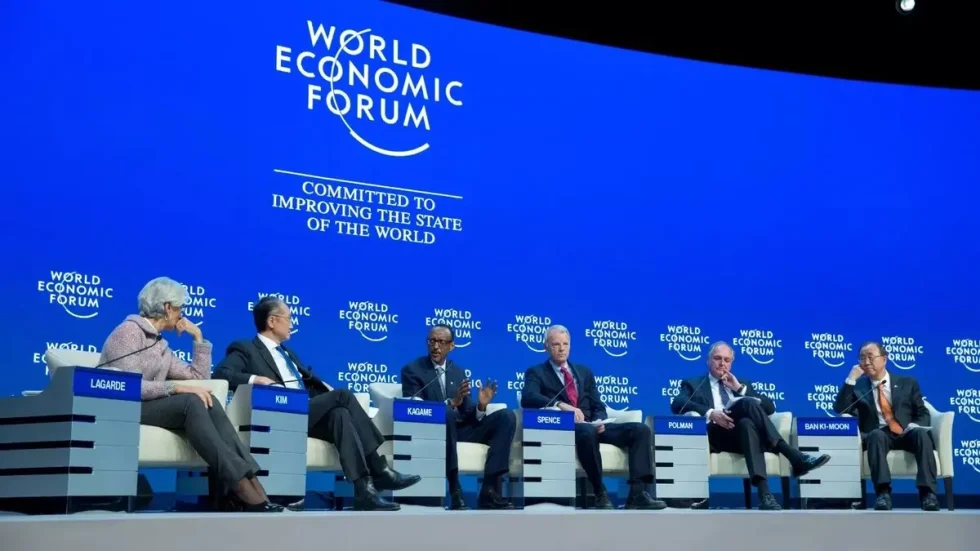
The World Economic Forum (WEF) stunned participants this year replacing its usual panels and keynote speeches with a series of escape room challenges. Instead of sitting on stage discussing inequality and trade, billionaires and world leaders were locked in themed rooms and forced to solve riddles, decode ciphers, and locate hidden keys to “unlock” policy outcomes.
Organizers argued that traditional panels had grown stale and that immersive problem-solving would foster genuine cooperation. “If global leaders can work together to find a hidden clue under a couch cushion, maybe they can also work together on climate policy,” one organizer explained.
How It Worked
Each escape room was themed around global issues. The “Climate Crisis Room” featured melting ice sculptures and required participants to assemble a wind turbine model. The “Debt Ceiling Dungeon” challenged leaders to balance oversized foam coins on a teetering scale. The “Crypto Chaos Chamber” contained QR codes leading to fake wallets that had to be decrypted to progress.
Teams were mixed intentionally, pairing rival leaders and corporate executives. A leaked memo revealed that one room required a CEO and a finance minister to solve a jigsaw puzzle of renewable energy charts before the clock ran out.
Market Reactions
Markets watched nervously as rumors spread about how effectively leaders performed in the escape rooms. Stocks dipped when reports suggested one team failed to escape the “Supply Chain Maze” in time. Meme coins like $ESCAPE and $CLUE surged in value as traders gamified the event.
Analysts admitted they were unsure how to interpret market risks based on puzzle-solving skills. One strategist asked, “If a minister cannot find a hidden key, does that mean inflation is here to stay?”
Political Fallout
Some leaders praised the new approach. “It was the first time I saw rival nations laughing together,” said one European delegate. Others condemned it as unserious, warning that complex issues were being reduced to entertainment.
The United States delegation boasted that it escaped every room with record speed, while France accused the organizers of giving English-language hints that disadvantaged non-native speakers. Developing nations criticized the event for ignoring real-world struggles while elites played games.
Public Response
The public was fascinated. TikTok creators re-enacted the escape rooms using cardboard props, while Twitter trended with hashtags like #EscapeWEF and #PuzzlePolicy. On Reddit, one thread speculated which leaders were best at solving riddles, with users betting heavily on Germany’s reputation for efficiency.
One viral meme showed billionaires frantically searching for keys with the caption: “Still easier than paying taxes.”
Expert Opinions
Economists expressed skepticism. Dr. Omar Hossain argued, “Turning policy debates into escape games trivializes real crises. Global inequality cannot be solved with a jigsaw puzzle.”
Dr. Emily Carter countered that gamification might enhance collaboration. “Traditional summits often result in vague statements. Escape rooms at least force participants to actively engage, even if the outcomes are symbolic.”
Symbolism in the Absurd
Cultural analysts suggested the shift reflected the performative nature of modern politics. “Global summits are already theater,” one critic said. “The escape room format simply makes the metaphor literal.”
Some argued the event captured the essence of global challenges: locked doors, hidden solutions, and a ticking clock.
Conclusion
The World Economic Forum’s transformation into an elaborate escape room may be ridiculed as a gimmick, but it has successfully drawn attention to the absurdity of global decision-making. Whether remembered as a bold experiment or a distraction from serious policy, it highlights how far institutions will go to stay relevant.
For now, one lesson is clear. In 2025, the key to solving the world’s problems might literally be hidden under a rug.
Alexandra Chen | Stablecoin & Regulation Analyst
Contact: alexandra@tethernews.net